Story Summary
Discover the Caribbean trickster tale Compé Lapin and Compé Tiger. See how a clever rabbit uses his wits to turn a hungry predator into his own riding horse.
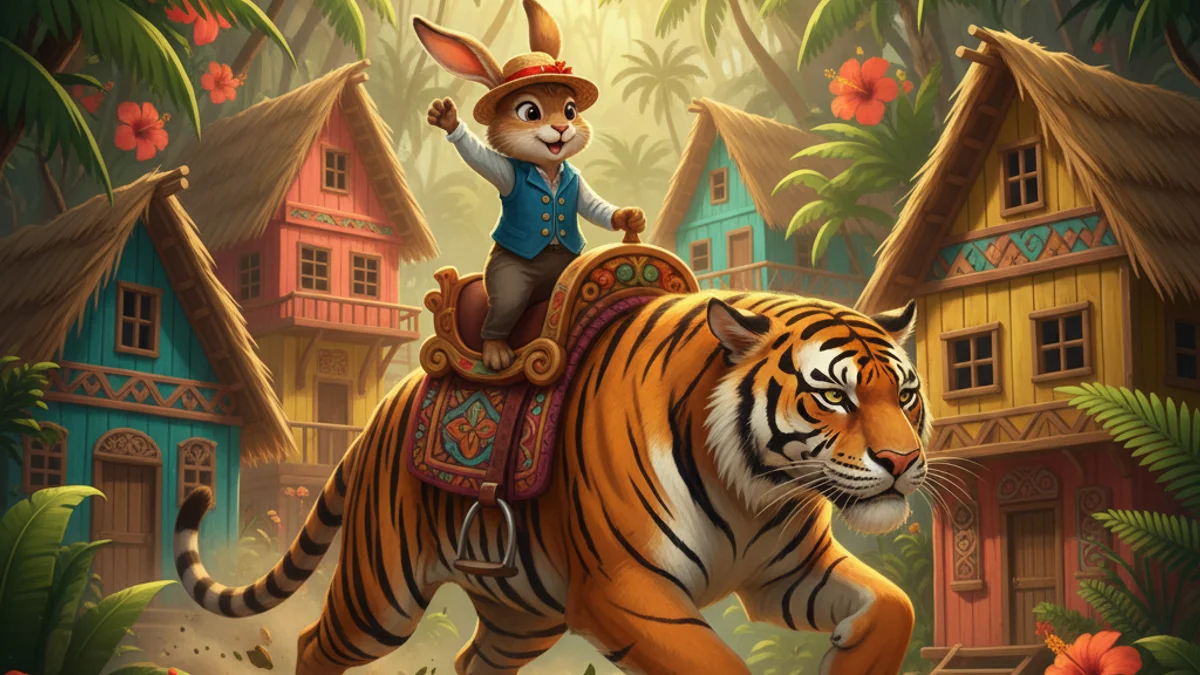
Compé Tiger was the strongest beast in the forest, and he had decided that the clever Compé Lapin would make a fine dinner. Knowing he could never outrun the predator, Lapin feigned a terrible illness when Tiger arrived at his door to fetch him. 'Oh, Compé Tiger,' Lapin groaned, 'I am far too weak to walk to your house to be eaten. If only I could ride there on your back, I might make it.' Eager to get his meal home, the vain Tiger agreed. Lapin then insisted on a saddle and bridle 'just to keep steady' in his weakened state. Thinking only of his stomach, Tiger complied. As they approached the village where the beautiful ladies lived, Lapin suddenly sat upright, pulled the reins, and dug in his heels. 'Look!' Lapin shouted to the gathering crowd, 'The mighty Compé Tiger is nothing more than my personal riding horse!' Humiliated by the laughter of the villagers and the rabbit's superior wit, Tiger bolted into the deep brush, leaving Lapin to enjoy his victory.
The Moral
Wit and intelligence are far more powerful than raw physical strength. A clever mind can turn a predator's own vanity into their downfall.
“Look! The mighty Compé Tiger is nothing more than my personal riding horse!”
Fun Fact
Compé Lapin stories are particularly prominent in the folklore of Haiti, Martinique, St. Lucia, and Louisiana, reflecting the deep French-Creole influence in those regions.
Frequently Asked Questions
What is the moral of Compé Lapin and Compé Tiger?
The moral is that intelligence and quick thinking are more effective than brute force. It demonstrates that even the smallest individual can overcome a powerful bully by using their wits.
Who is Compé Lapin in Caribbean folklore?
Compé Lapin is a famous trickster character, often portrayed as a clever rabbit who uses his intellect to outsmart larger, more dangerous animals. He is the Caribbean equivalent of Brer Rabbit or the West African Hare.
What does 'Compé' mean in the context of these stories?
The term 'Compé' or 'Compère' is derived from French and Creole, meaning 'friend,' 'companion,' or 'godfather.' It is used as a respectful yet familiar title between the animals in the stories.
What is the origin of the Compé Lapin stories?
These stories originated from West African oral traditions brought to the Caribbean by enslaved people. Over time, they blended with French, Spanish, and Indigenous influences to become a staple of Caribbean folklore.
Is Compé Lapin the same as Brer Rabbit?
Yes, they share the same cultural ancestry. While the names and specific settings change across the Caribbean and the American South, the character's personality as a small but brilliant trickster remains the same.
Why does Compé Lapin always win?
He wins because he understands the weaknesses of his opponents, such as Tiger's vanity or greed. His victories serve as allegories for how marginalized individuals can navigate and survive in a world ruled by those with more power.
Discussion (0)
Share your thoughts on this story
No comments yet. Be the first to share your thoughts!