Story Summary
In the Egyptian afterlife, souls face The Weighing of the Heart. Discover how the gods judge truth against a feather to decide a soul's eternal destiny.
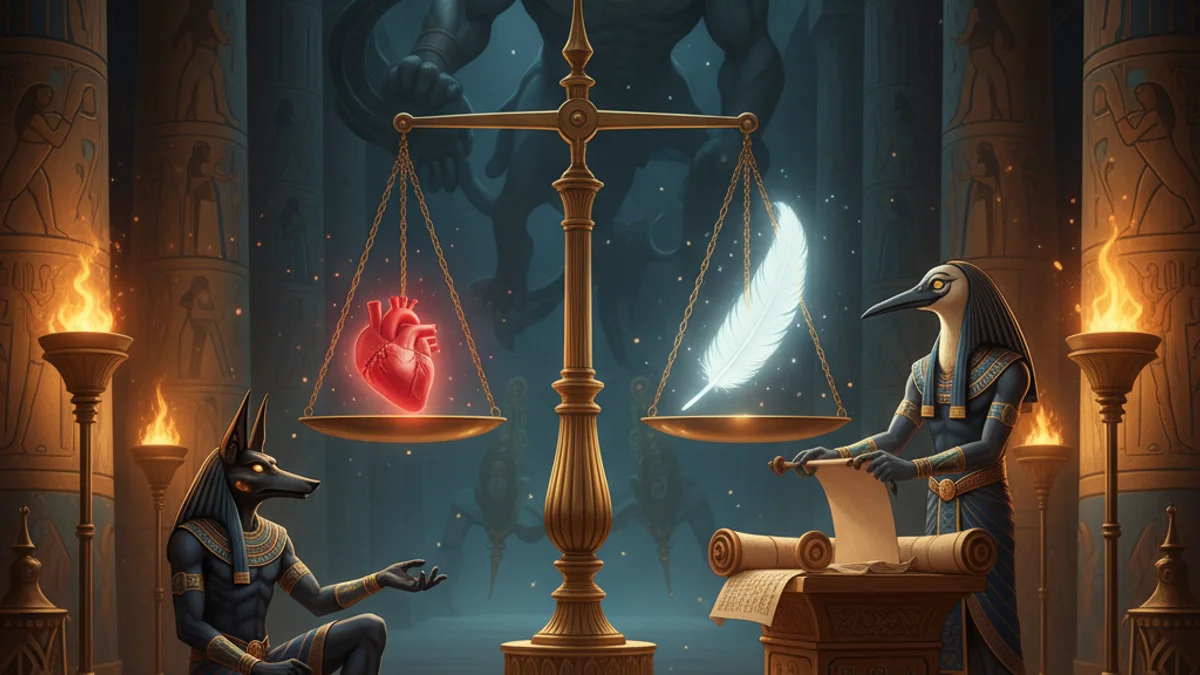
In the ancient Hall of Ma'at, the Egyptian afterlife reached its most critical moment. A deceased soul, guided by the jackal-headed Anubis, stood before a great golden scale. To earn a place in the Field of Reeds, the deceased had to undergo the 'Weighing of the Heart.' On one side of the scale sat the person's heart, heavy with the memories and deeds of their life. On the other side lay the white ostrich feather of Ma'at, representing truth, justice, and cosmic order. While the ibis-headed Thoth stood ready to record the verdict, the soul recited the Forty-Two Negative Confessions, swearing they had committed no sin. If the heart was lighter than or equal to the feather, the soul was welcomed by Osiris into eternal paradise. However, if the heart was heavy with the weight of wickedness, it was instantly devoured by Ammit, the 'Devourer of the Dead'—a terrifying beast with the head of a crocodile, the body of a lion, and the hindquarters of a hippopotamus—and the soul would cease to exist forever.
The Moral
True peace in the afterlife is earned through a life lived with integrity, honesty, and balance.
“May my heart not rise up against me as a witness.”
Fun Fact
Ancient Egyptians often placed 'heart scarab' amulets over the hearts of the deceased, inscribed with spells to prevent the heart from testifying against its owner during the judgment.
Frequently Asked Questions
What is the moral of The Weighing of the Heart?
The moral is that one's actions in life have eternal consequences. It emphasizes that living a life of truth, justice, and kindness is the only way to achieve ultimate peace and spiritual immortality.
Who is Ammit in Egyptian mythology?
Ammit, known as the 'Devourer of the Dead,' is a demon with the features of a crocodile, lion, and hippopotamus. She sits by the scales of Ma'at to consume the hearts of those judged unworthy, resulting in their total soul destruction.
What happens if the heart is heavier than the feather?
If the heart is heavier than the feather, it signifies the person lived a life of sin and imbalance. The heart is thrown to the monster Ammit to be eaten, and the soul is denied entry to the afterlife, vanishing into non-existence.
What are the 42 Negative Confessions?
These were a series of declarations made by the deceased to the gods, stating they had not committed specific sins such as stealing, killing, or lying. They served as a testimony of the person's purity and adherence to cosmic law.
Which god guides the soul to the scales?
Anubis, the god of mummification and the afterlife, typically guides the souls through the underworld to the Hall of Truth. He is often depicted physically adjusting the scales to ensure a fair and accurate weighing.
What does the feather of Ma'at represent?
The feather represents the goddess Ma'at and the concepts of truth, balance, order, and harmony. It serves as the ultimate cosmic standard against which every human life is measured during the final judgment.
Discussion (0)
Share your thoughts on this story
No comments yet. Be the first to share your thoughts!