Story Summary
In Aesop's classic fable The Oak and the Reed, a mighty tree's pride leads to its downfall during a storm, while the flexible reed survives by yielding.
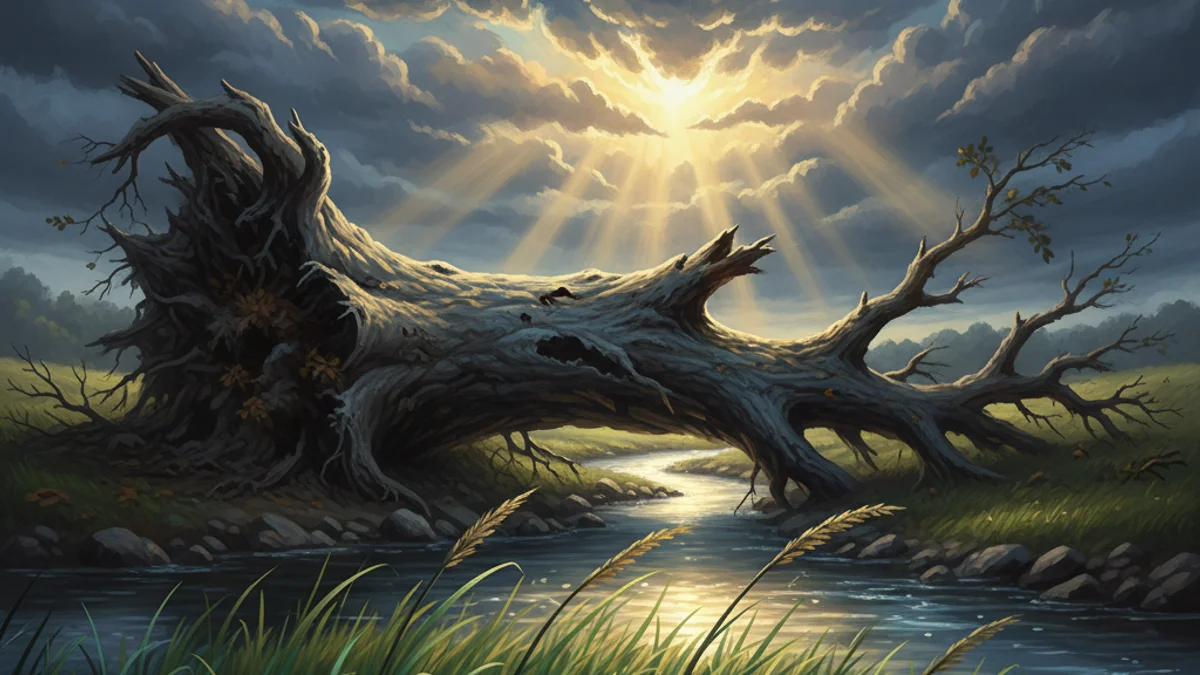
A mighty Oak tree stood proudly on the bank of a river, its thick trunk and sprawling branches mocking the slender Reeds that grew in the water below. 'How pitiful you are,' the Oak boasted, 'trembling at every breath of air, while I stand firm and immovable against the fiercest gales.' The Reeds said nothing, simply swaying as a light breeze passed. That night, a terrifying hurricane swept across the valley. The Oak stood rigid, digging its roots deep and fighting the wind with all its strength. But the storm was too powerful; with a deafening crack, the great tree was uprooted and cast into the river. The Reeds, however, simply bent low to the water, letting the wind whistle harmlessly over them. When morning came, the Reeds stood tall and unharmed, while the proud Oak was swept away by the current.
The Moral
It is better to bend and survive than to resist and be broken by pride.
“I bend and do not break.”
Fun Fact
This fable was famously reimagined by the French poet Jean de La Fontaine, whose version is considered a masterpiece of 17th-century literature.
Frequently Asked Questions
What is the moral of The Oak and the Reed?
The moral is that flexibility and humility are often greater strengths than rigid pride. By yielding to forces we cannot change, we ensure our survival while those who resist stubbornly may be destroyed.
Why did the Oak tree fall while the Reed survived?
The Oak fell because it tried to resist the full force of the hurricane with brute strength, causing its roots to snap under pressure. The Reed survived because it was flexible enough to bend with the wind, letting the destructive force pass over it.
Who wrote the story of The Oak and the Reed?
This fable is traditionally attributed to Aesop, an ancient Greek storyteller who lived around 620 to 564 BCE. It has since been adapted by many famous writers, including Jean de La Fontaine.
Is The Oak and the Reed a metaphor for life?
Yes, it serves as a metaphor for human behavior, suggesting that being adaptable in the face of adversity is better than being stubborn. It teaches that being 'soft' can sometimes be more resilient than being 'hard'.
What does the Reed represent in the story?
The Reed represents humility, adaptability, and the wisdom of knowing when to yield. It demonstrates that appearing weak can actually be a strategic advantage during a crisis.
How does this fable apply to modern times?
In the modern world, this fable encourages 'cognitive flexibility' and emotional resilience. It suggests that individuals and businesses that adapt to change thrive, while those who remain rigid often fail.