Story Summary
Discover the Jataka tale of The Swan's Golden Feathers. A story of a father reborn as a golden swan who teaches his family the dangers of greed and loss.
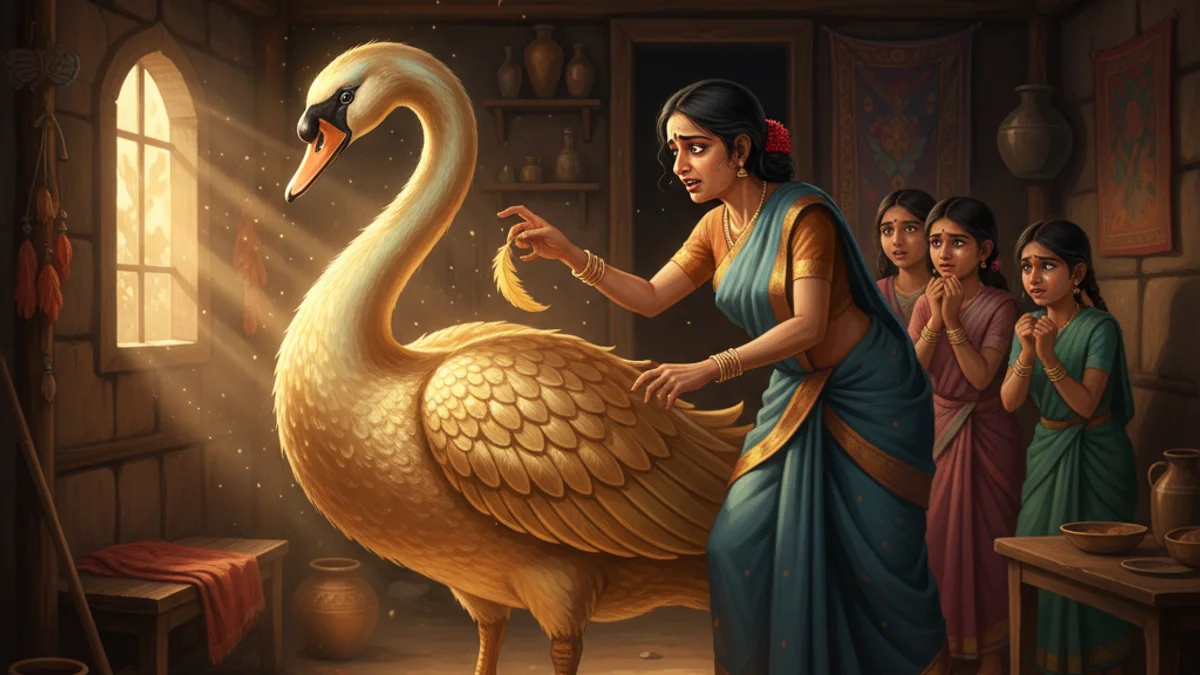
Long ago, the Bodhisattva was born as a Brahmin who lived a virtuous life with his wife and three daughters. After his death, he was reborn as a swan with feathers of pure gold. Looking down from the heavens, he saw his family living in poverty, working as servants to survive. Moved by compassion, he flew to their home and revealed his identity, promising to give them one golden feather periodically so they could live in comfort. For a long time, the family lived well by selling the feathers. However, the mother grew greedy, fearing the swan might one day stop visiting. She proposed to her daughters that they pluck all his feathers at once to secure their fortune. Despite the daughters' protests, the mother seized the swan during his next visit and tore out every feather. To her horror, because the feathers were taken by force and greed rather than given freely, they instantly transformed into common white crane feathers. The swan eventually grew back his wings—but only with white feathers—and flew away forever, leaving the greedy woman to fall back into the poverty she so desperately tried to avoid.
The Moral
Greed yields nothing but loss; one should be content with what is given rather than grasping for more.
“Contentment is the greatest wealth; greed only turns gold into dross.”
Fun Fact
This story is identified as Jataka No. 136 in the Pali Canon and has been used for over two millennia to teach the Buddhist concept of 'Appicchatā' or 'having few wants.'
Frequently Asked Questions
What is the moral of The Swan's Golden Feathers?
The moral is that greed leads to the loss of what one already has. It teaches that contentment and patience are far more valuable than the pursuit of excessive wealth.
Who was the golden swan in a past life?
The golden swan was the rebirth of a Brahmin who was the father of the family. He returned in this form out of compassion to help his wife and daughters escape poverty.
Why did the golden feathers turn into white feathers?
The feathers turned white because they were taken through force and greed. The magic of the gift relied on the swan's willingness to give; once stolen, the treasure lost its value.
How does this Jataka tale relate to Aesop's fables?
This story is a clear precursor to the Western fable 'The Goose That Laid the Golden Eggs.' Both stories share the central theme of destroying a source of wealth through short-sighted greed.
What happened to the swan at the end of the story?
After his golden feathers were plucked and replaced by white ones, the swan eventually grew strong enough to fly. He departed and never returned to his family, as they had proven themselves unworthy of his help.
What does the swan represent in Buddhist teachings?
The swan represents the Bodhisattva, a being on the path to enlightenment who acts with selflessness and compassion to alleviate the suffering of others.
Discussion (0)
Share your thoughts on this story
No comments yet. Be the first to share your thoughts!