Story Summary
Explore the classic Zen story The Empty Cup. Learn why a brilliant professor had to empty his mind to receive the wisdom of Zen master Nan-in in this fable.
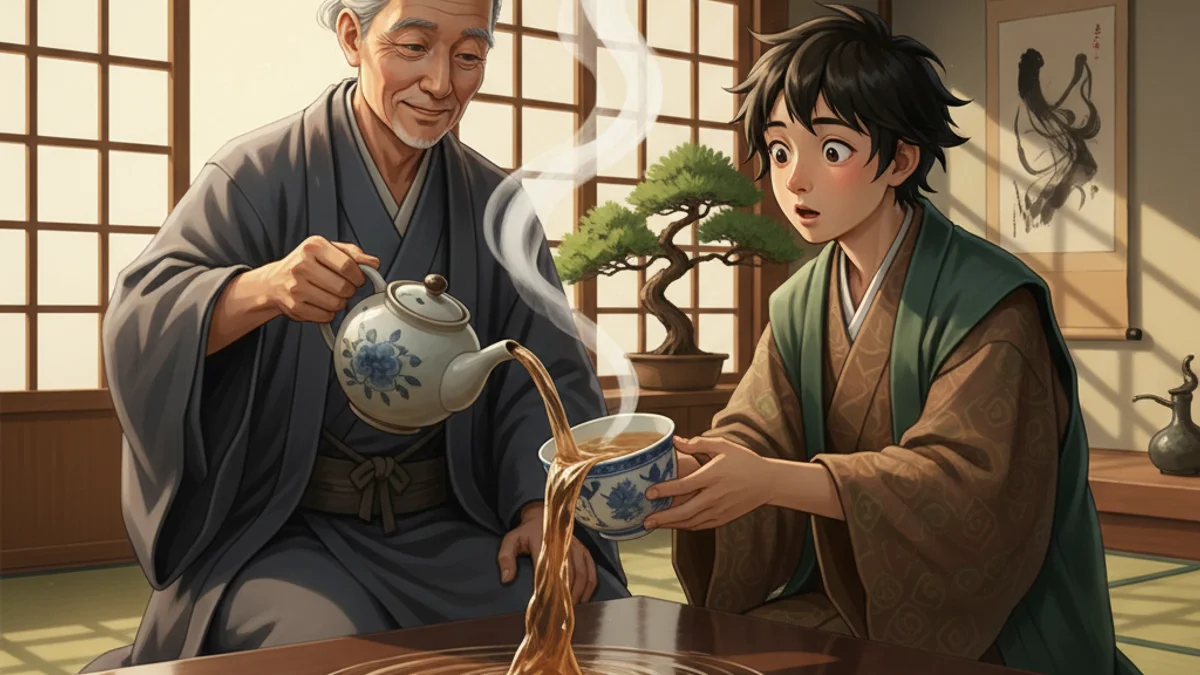
A university professor went to visit a famous Zen master named Nan-in to inquire about Zen. As the professor spoke, it became clear he was more interested in showing off his own knowledge than in listening. He lectured at length about his theories and opinions. Nan-in served tea. He poured his visitor's cup full, and then kept on pouring. The professor watched the tea overflow until he could no longer restrain himself. 'It is overfull. No more will go in!' he exclaimed. 'Like this cup,' Nan-in replied, 'you are full of your own opinions and speculations. How can I show you Zen unless you first empty your cup?'
The Moral
To acquire new wisdom and learn effectively, one must first set aside preconceived notions, ego, and existing biases.
“How can I show you Zen unless you first empty your cup?”
Fun Fact
This story is frequently associated with the concept of 'Shoshin' (Beginner's Mind), a term popularized in the West by Shunryu Suzuki in his book 'Zen Mind, Beginner's Mind.'
Frequently Asked Questions
What is the moral of The Empty Cup?
The moral is that an open and humble mind is necessary for learning. If you are already full of your own opinions, there is no room for new information or wisdom to enter.
Who is the Zen master in the story?
The master is Nan-in, a Japanese Zen master who lived during the Meiji era (1868–1912). He was known for his direct and unconventional teaching methods.
What does the overflowing tea symbolize?
The overflowing tea symbolizes the professor's mind, which is so crowded with his own theories, ego, and academic knowledge that he cannot absorb anything new from the master.
How does this story relate to the concept of Shoshin?
Shoshin, or 'beginner’s mind,' is the Zen practice of approaching subjects with lack of prejudice and openness, exactly what the professor lacked in this story.
Why is 'The Empty Cup' important in martial arts?
It is often told to students to remind them that their previous experience or rank shouldn't prevent them from learning new techniques from a different master or style.
How can I apply 'The Empty Cup' to my daily life?
You can apply it by practicing active listening and approaching every conversation or new task with the humility of a student, rather than assuming you already know everything.
Discussion (0)
Share your thoughts on this story
No comments yet. Be the first to share your thoughts!