Story Summary
Discover the legend of Khufu and the Magicians as the Pharaoh hears tales of ancient wonders and meets Djedi, the sage who holds the secrets of the gods.
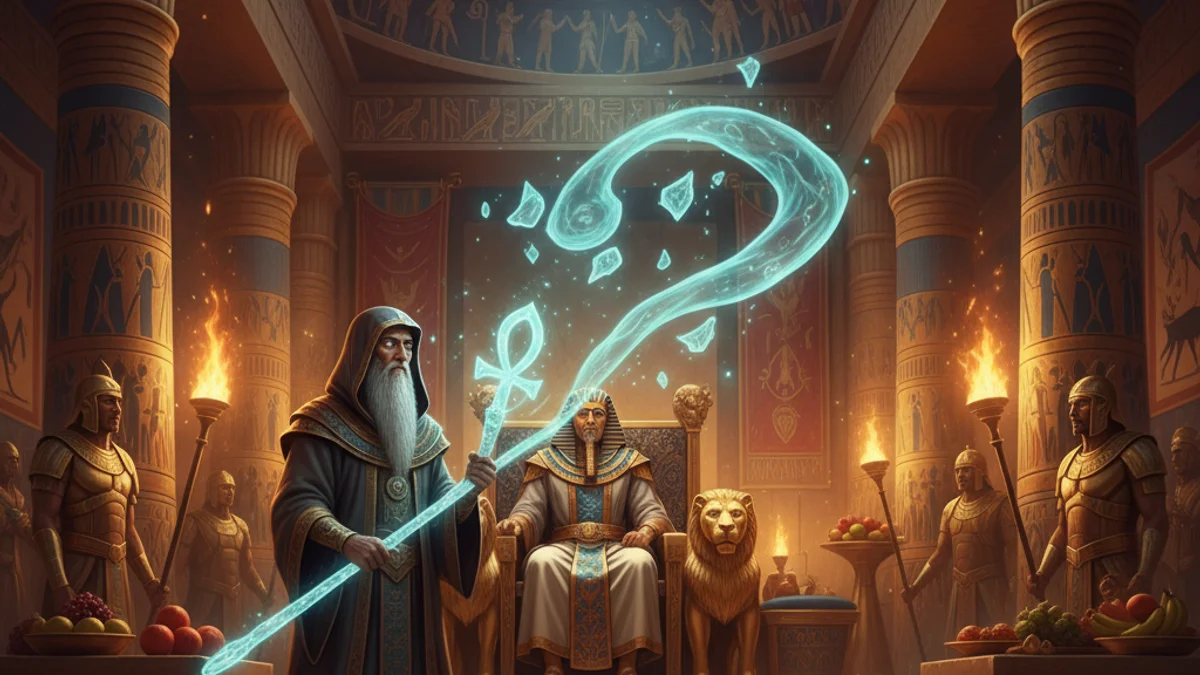
Pharaoh Khufu, the builder of the Great Pyramid, sat restless in his palace and summoned his sons to entertain him with tales of ancient wonders. Prince Khafre spoke of a magician who fashioned a wax crocodile that grew to life to punish an adulterer. Prince Baufré told of a priest who parted the waters of a lake to recover a lost turquoise pendant. Yet, Prince Hardedef promised something greater: a living magician named Djedi, who dwelt in Djed-Sneferu. Khufu sent for the sage, a man of one hundred and ten years who ate five hundred loaves of bread and drank one hundred jugs of beer daily. When Djedi arrived, Khufu asked if he could truly reattach a severed head. To test him, the Pharaoh ordered a prisoner to be executed. Djedi refused, saying, 'Not to a human, O King my lord; for the noble flock of God must not be so treated.' Instead, Djedi performed his magic on a goose, a waterfowl, and an ox, seamlessly rejoining their heads to their bodies. Finally, Khufu asked Djedi for the secrets of the sanctuary of Thoth. Djedi revealed that he did not possess them, but they would be brought by the eldest of three sons to be born to the wife of a priest of Ra—children who would one day take the throne. Khufu was saddened by the end of his line, but Djedi comforted him, promising that Khufu’s son and grandson would still reign before the change of dynasties.
The Moral
True power is tempered by wisdom and respect for life, and even the greatest kings must accept the divine transition of time and destiny.
“A human being is the noble flock of the god; one must not do such a thing to him.”
Fun Fact
This story is one of the oldest examples of 'nested storytelling' or a frame narrative, a literary technique later made famous by The Arabian Nights.
Frequently Asked Questions
What is the moral of Khufu and the Magicians?
The moral is that respect for life is a divine duty, and that destiny is determined by the gods rather than the will of a king. It emphasizes that power should be handled with wisdom and humility.
Who was Djedi in Egyptian mythology?
Djedi was a legendary commoner and magician reputed to be 110 years old. He was famous for his incredible appetite, his ability to reattach severed heads, and his knowledge of the secrets of the god Thoth.
What is the Westcar Papyrus?
The Westcar Papyrus is the ancient Egyptian text that contains the stories of Khufu and the Magicians. It dates back to the Second Intermediate Period, though the stories themselves are set during the Old Kingdom.
Why did Djedi refuse to perform magic on a prisoner?
Djedi refused because he believed that human beings are the 'noble flock of God.' He argued that such magic should not be practiced on humans, showing a high moral regard for life that impressed the Pharaoh.
What prophecy did Djedi give to Pharaoh Khufu?
Djedi prophesied that the wife of a priest of Ra would give birth to three sons who would become kings. This foretold the rise of the Fifth Dynasty, signaling the eventual end of Khufu's own dynastic line.
Which miracles are performed in the story?
The story features several miracles: the creation of a living wax crocodile, the parting of lake waters to find jewelry, and Djedi reattaching the heads of a goose, a duck, and an ox.
Discussion (0)
Share your thoughts on this story
No comments yet. Be the first to share your thoughts!