Story Summary
Discover the tale of The Tower of Babel, where humanity's pride led to the confusion of languages and the scattering of nations across the ancient world.
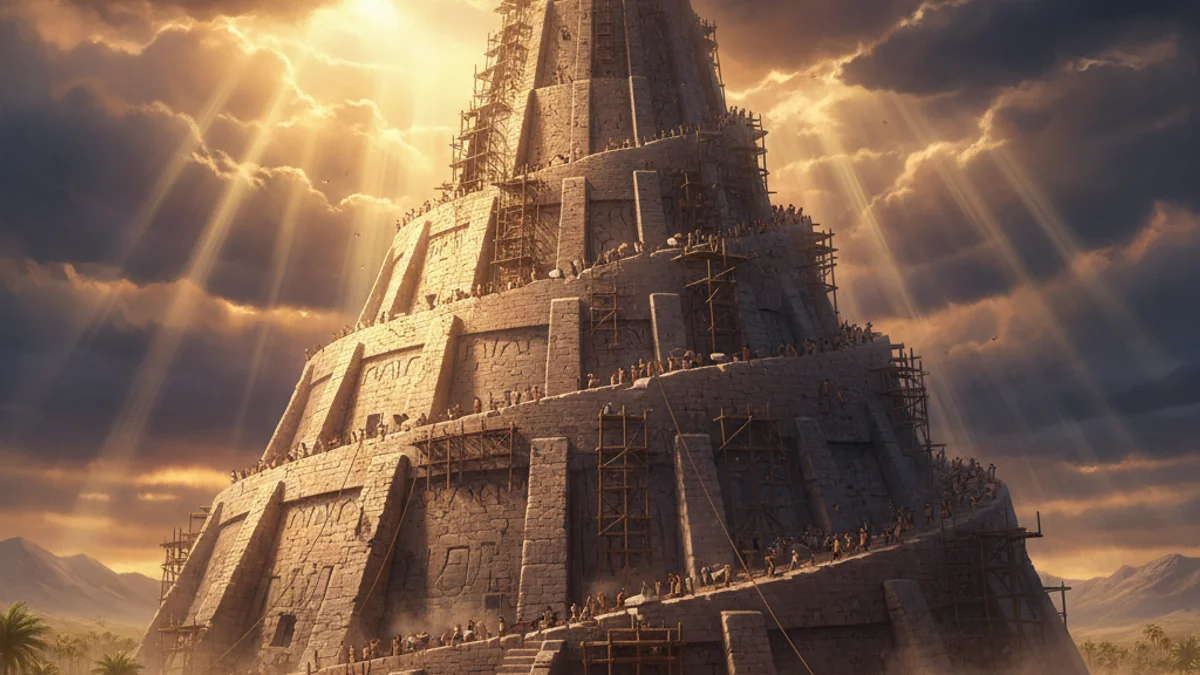
Following the Great Flood, the descendants of Noah migrated eastward and settled in the plain of Shinar. United by a single language and a common purpose, they sought to secure their legacy through a monument of their own greatness. 'Come,' they said, 'let us build ourselves a city, and a tower with its top in the heavens, and let us make a name for ourselves.' They labored tirelessly with brick and bitumen, their structure rising higher into the sky with every passing day. God looked down upon their work and saw that their ambition was rooted in pride rather than piety. Observing that their unified language allowed them to achieve any feat—including those that challenged divine order—He decided to intervene. God confounded their speech so they could no longer understand one another. Construction ground to a sudden halt as arguments and confusion broke out among the workers. Unable to communicate, the people abandoned the city and scattered across the face of the earth, giving rise to the many nations and languages of the world.
The Moral
Pride and human hubris lead to downfall, reminding us that true unity cannot be built on vanity alone.
“Come, let us build ourselves a city, and a tower with its top in the heavens.”
Fun Fact
The word 'Babel' is a play on the Hebrew word 'balal' meaning to confuse, while in the original Akkadian, 'Bab-ilu' actually means 'Gate of God'.
Frequently Asked Questions
What is the moral of The Tower of Babel?
The story warns against human hubris and the desire to equate oneself with the divine. It teaches that true unity requires humility and alignment with a higher purpose rather than selfish ambition.
Why did God stop the construction?
God intervened because he saw that humanity's absolute unity in their pride would lead them to believe they could achieve anything without divine guidance. By confusing their speech, He forced them to spread across the earth as originally intended.
What does the name 'Babel' mean?
In the biblical context, the name is derived from the Hebrew word 'balal,' which means 'to confuse.' It serves as a linguistic pun on the confusion of tongues that took place there.
Is the Tower of Babel based on a real building?
Many scholars believe the story was inspired by the Etemenanki, a massive ziggurat in Babylon dedicated to the god Marduk. These structures were common in Mesopotamia and were designed to connect the earth with the heavens.
Where was the Tower of Babel located?
According to the Torah, the tower was built in the land of Shinar, which is widely identified as the region of Mesopotamia in modern-day Iraq. This area was the heart of the ancient Babylonian civilization.
How many languages were created at Babel?
While the text doesn't specify a number, Jewish tradition often suggests there were seventy primary nations and languages formed. This event explains the cultural and linguistic diversity seen throughout the world today.
Discussion (0)
Share your thoughts on this story
No comments yet. Be the first to share your thoughts!