Story Summary
Explore the daring journey of Napoleon Crosses the Alps. Learn how his 1800 mountain campaign demonstrated revolutionary leadership and changed European history.
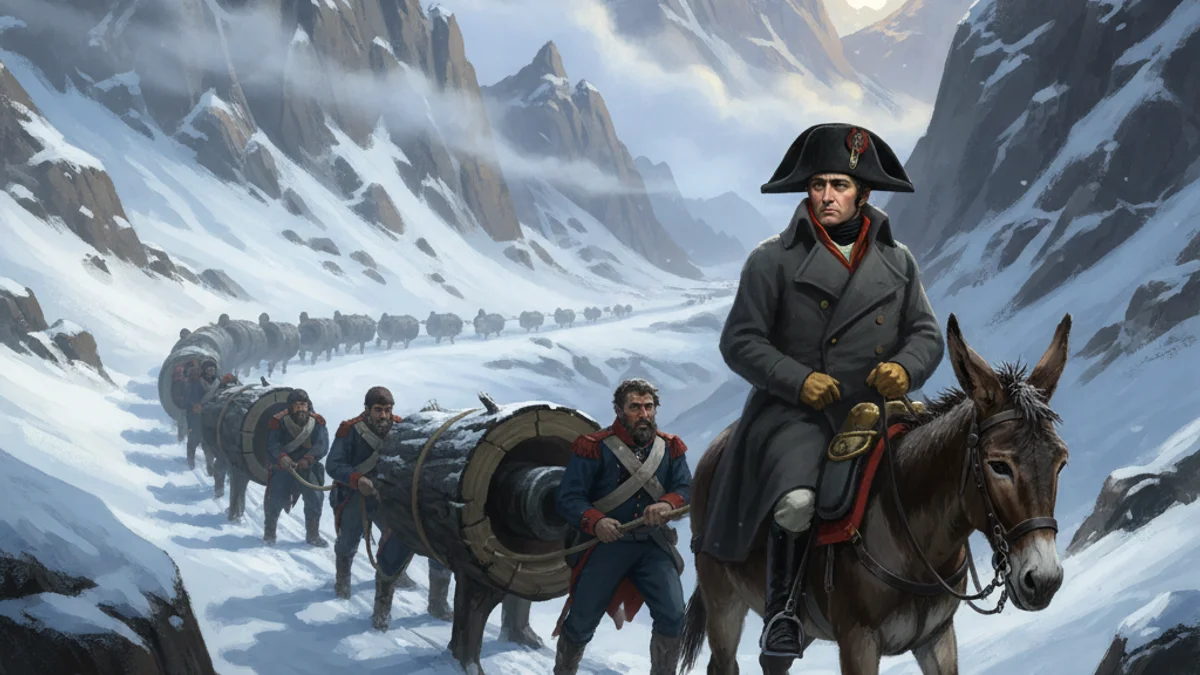
In May 1800, Napoleon Bonaparte faced a daunting challenge: the Austrian army held Northern Italy, protected by the seemingly impassable Great St. Bernard Pass. When his engineers warned that the path was treacherous and nearly blocked by snow, Napoleon famously replied, 'Impossible is not a French word.' He led forty thousand men through the freezing heights, pushing the limits of human endurance. To transport heavy artillery, his soldiers hollowed out pine logs to slide cannons over the ice and rocks. While Jacques-Louis David’s famous painting depicts him on a rearing stallion, Napoleon actually traversed the rugged terrain on a sure-footed mule, often walking to keep warm. This daring maneuver allowed him to descend onto the plains of Italy, catching his enemies completely off guard. His unwavering resolve proved that nature itself could be conquered by a leader with a clear vision and indomitable will.
The Moral
Great leaders turn obstacles into opportunities by refusing to accept the word 'impossible.' Success requires both bold vision and the willingness to endure hardships alongside those you lead.
“Impossible is a word to be found only in the dictionary of fools.”
Fun Fact
While the famous painting by David shows Napoleon looking heroic on a horse, he actually paid a local mountain guide to lead him across on a mule while he sat huddled in a simple overcoat.
Frequently Asked Questions
What is the moral of Napoleon Crosses the Alps?
Napoleon’s crossing teaches that determination and unconventional thinking can overcome any obstacle. It highlights that a leader’s willpower can inspire an entire army to achieve the impossible through preparation and grit.
Did Napoleon actually ride a white horse during the crossing?
Contrary to the famous painting by Jacques-Louis David, Napoleon actually rode a mule. Mules were much better suited for the narrow, slippery, and treacherous paths of the Great St. Bernard Pass than spirited horses.
When did Napoleon cross the Alps?
This historical event took place in May 1800 during the War of the Second Coalition. It was a strategic move designed to surprise the Austrian forces stationed in Italy by taking a route they considered impossible.
Which mountain pass did Napoleon use?
Napoleon led his Reserve Army through the Great St. Bernard Pass. At an altitude of over 8,000 feet, it was one of the most difficult and dangerous routes through the Alps at that time of year.
How did the army move their cannons?
To get heavy artillery through the deep snow, the soldiers used hollowed-out tree trunks as sleds. They placed the cannons inside these logs and manually dragged them over the ice and rocks using ropes.
What was the result of this military campaign?
The successful crossing allowed Napoleon to surprise the Austrians from the rear. This led directly to the decisive French victory at the Battle of Marengo, which helped secure Napoleon's political power in France.