Story Summary
Witness the tactical genius of Napoleon at Austerlitz as he outmaneuvers the Russian and Austrian empires in his greatest military triumph and leadership masterclass.
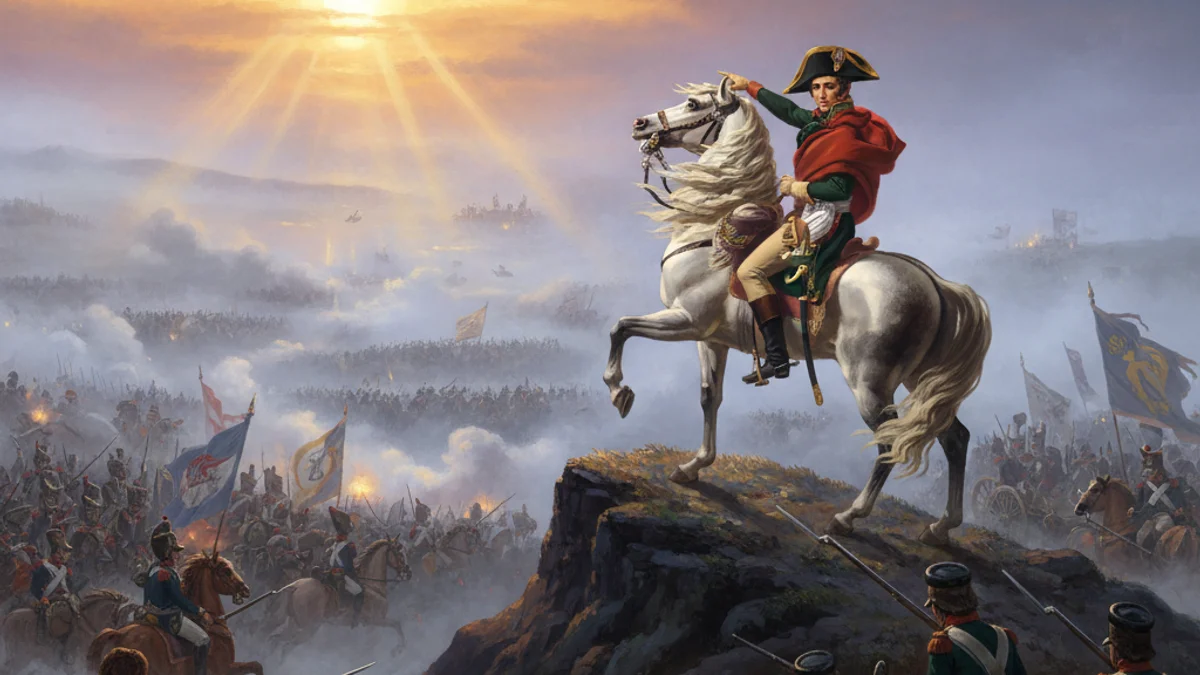
In December 1805, Napoleon Bonaparte faced his greatest challenge on the fields of Austerlitz. Outnumbered by the combined forces of the Russian and Austrian Empires, the French Emperor didn't retreat; he orchestrated a masterpiece of deception. He deliberately weakened his right flank, tempting the Allied commanders to abandon the high ground of the Pratzen Heights to attack what appeared to be a vulnerable spot. As the morning mist lifted—revealing the famous 'Sun of Austerlitz'—Napoleon launched Marshal Soult’s corps directly at the weakened Allied center. The maneuver cut the enemy army in two, sowing chaos and securing a decisive victory. Throughout the chaos, Napoleon remained a beacon of calm, his presence alone steadying his troops and proving that a battle is won in the mind long before it is won on the field.
The Moral
True leadership and victory stem from the ability to remain calm, think strategically, and turn an opponent's perceived strength into their greatest weakness.
“Soldiers, I am pleased with you. On the day of the anniversary of my coronation, you have wiped out the shame of your defeats.”
Fun Fact
The Battle of Austerlitz was so decisive that it led to the collapse of the Holy Roman Empire, an institution that had survived for over 1,000 years.
Frequently Asked Questions
What is the moral of Napoleon at Austerlitz?
The moral is that strategic intelligence and psychological insight are more powerful than sheer numbers. Success comes to those who can master their environment and anticipate their opponent's moves through calm observation.
Why is Austerlitz called the Battle of the Three Emperors?
It earned this name because the three most powerful monarchs of Europe—Napoleon of France, Alexander I of Russia, and Francis II of Austria—were all present on the battlefield leading their respective armies.
What was the 'Sun of Austerlitz'?
It refers to the moment the morning fog cleared to reveal a bright sun, which Napoleon took as a divine omen of victory just as his troops began their decisive ascent of the Pratzen Heights.
How did Napoleon use deception during the battle?
Napoleon feigned weakness by abandoning the strategic Pratzen Heights and thinning his right flank, tricking the Allies into attacking where he wanted them to, which exposed their own center to his counter-attack.
What was the historical impact of this victory?
The victory led to the Treaty of Pressburg, effectively ending the Third Coalition and resulting in the dissolution of the Holy Roman Empire after a thousand years of existence.
What leadership traits did Napoleon display at Austerlitz?
He displayed supreme confidence, tactical flexibility, and the ability to inspire his men. His calm demeanor under pressure allowed him to execute a complex plan with perfect timing.