Story Summary
Discover the classic tale of Androcles and the Lion, where an escaped slave's mercy toward a wounded beast leads to an unexpected act of gratitude in the arena.
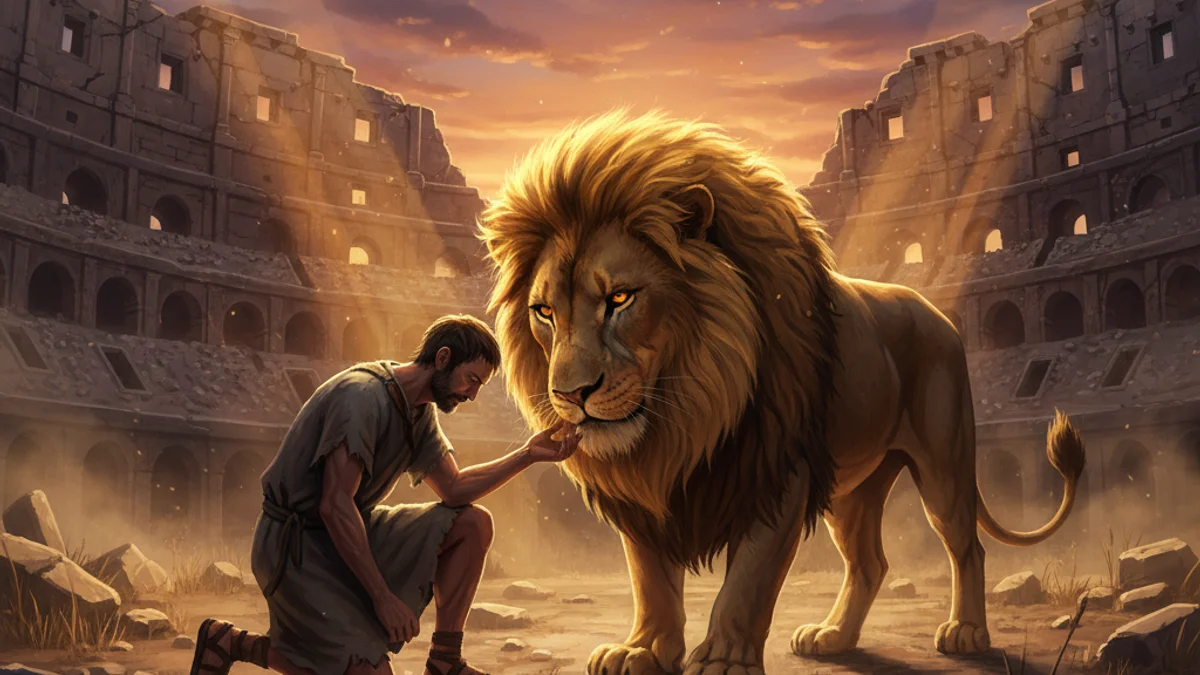
In ancient Rome, a slave named Androcles fled from his cruel master into the forest. Seeking shelter in a cave, he encountered a lion moaning in agony. Though terrified, Androcles noticed a large thorn embedded in the beast's swollen paw. He plucked it out, and the lion, in gratitude, licked his hand like a dog. Sometime later, both were captured. As punishment for his escape, Androcles was thrown into the arena to face a starving lion. When the beast was released, it charged toward him, only to stop and nuzzle him gently. The Emperor, astonished by the creature's mercy, granted both the man and the lion their freedom.
The Moral
Kindness is never wasted, and gratitude is the sign of a noble soul.
“Gratitude is the sign of noble souls.”
Fun Fact
This story was famously adapted into a comedic play by George Bernard Shaw in 1912, which added a more satirical and intellectual layer to the fable.
Frequently Asked Questions
What is the moral of Androcles and the Lion?
The moral is that kindness is never wasted and even the most ferocious creatures can feel gratitude. It teaches us that mercy shown to others often returns to us in our hour of need.
Is Androcles and the Lion a true story?
While often categorized as an Aesop's fable, the story originates from Aulus Gellius’s 'Attic Nights'. He claimed it was a true account of an event that happened in Rome, though most historians view it as folklore.
Why was Androcles in the arena?
Androcles was an escaped slave in ancient Rome. At the time, captured runaway slaves were often sentenced to 'damnatio ad bestias,' which meant being thrown to wild animals in the Coliseum as punishment.
How did the lion recognize Androcles?
The lion recognized Androcles through scent and sight, remembering the man who had shown him compassion in the desert. The bond formed during the healing of the paw was stronger than the lion's hunger.
What did the Emperor do at the end of the story?
The Emperor was so moved by the spectacle of the lion's loyalty that he pardoned Androcles. He granted the man his freedom and ordered that the lion be released back into the wild.
What is the significance of the thorn in the story?
The thorn represents a small act of service that has a massive impact. It serves as the catalyst for a life-saving bond, proving that even a small gesture of help can be life-changing.