Story Summary
Discover the Panchatantra tale of The Lion-Makers, where three scholars use their magic to revive a predator, proving that common sense outweighs raw knowledge.
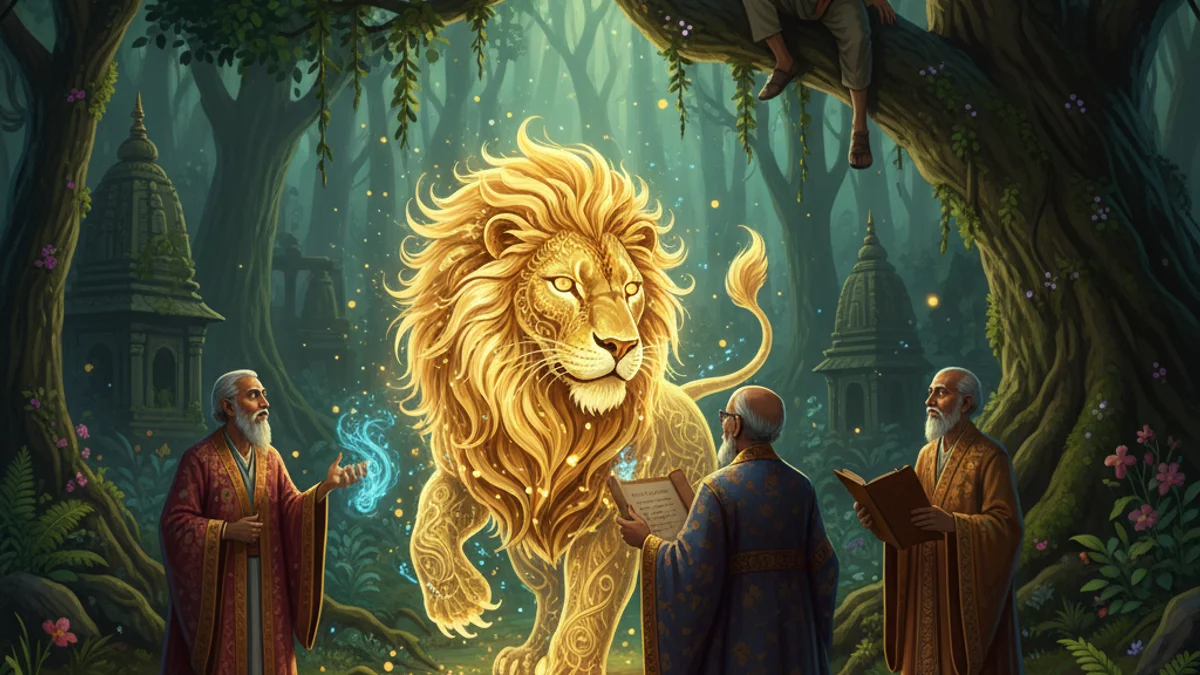
Four childhood friends lived in a city. Three were master scholars of the sciences but lacked common sense, while the fourth, Subuddhi, was not learned but possessed great practical wisdom. One day, they decided to travel to seek their fortunes. In a forest, they found the scattered bones of a dead lion. The first scholar said, 'I can assemble the skeleton.' The second said, 'I can provide the flesh, skin, and blood.' The third boasted, 'I can breathe life into it.' Subuddhi warned, 'Friends, this is a lion. If you give it life, it will devour us.' They ignored him, calling him a fool. While the third scholar prepared the spell, Subuddhi climbed a nearby tree. The lion came to life, instantly leaped upon the three scholars, and killed them. Subuddhi waited for the lion to leave, then climbed down and returned home safely.
The Moral
Practical wisdom is superior to scholarship; learning without common sense leads to disaster.
“Scholarship is less than sense; therefore seek intelligence.”
Fun Fact
The Panchatantra was originally composed to teach three young princes the art of 'niti' (wise conduct) through engaging stories.
Frequently Asked Questions
What is the moral of The Lion-Makers?
The story teaches that common sense and practical wisdom are more valuable than theoretical knowledge or academic brilliance. Intelligence is dangerous when not guided by a sense of reality.
Who wrote The Lion-Makers?
It is part of the Panchatantra, an ancient Indian collection of interrelated animal fables. It is traditionally attributed to the sage Vishnu Sharma.
Why did the three scholars ignore Subuddhi?
They were blinded by their own ego and pride in their scholarly achievements. They viewed his practical warning as the talk of an uneducated man who didn't understand their powers.
What happens at the end of The Lion-Makers?
The three learned friends are killed by the lion they resurrected. Only Subuddhi, who had the sense to climb a tree, survives to return home.
Is The Lion-Makers a Panchatantra story?
Yes, it is one of the most famous tales from the Panchatantra, specifically found in the section regarding ill-considered actions.
What does the lion symbolize in the story?
The lion represents a dangerous consequence or a reality that cannot be controlled, illustrating that some powers are better left untouched regardless of one's ability to use them.