Story Summary
Experience the profound Jataka tale of The Hungry Tigress, where Prince Mahasattva sacrifices himself to save a starving predator and her young cubs from death.
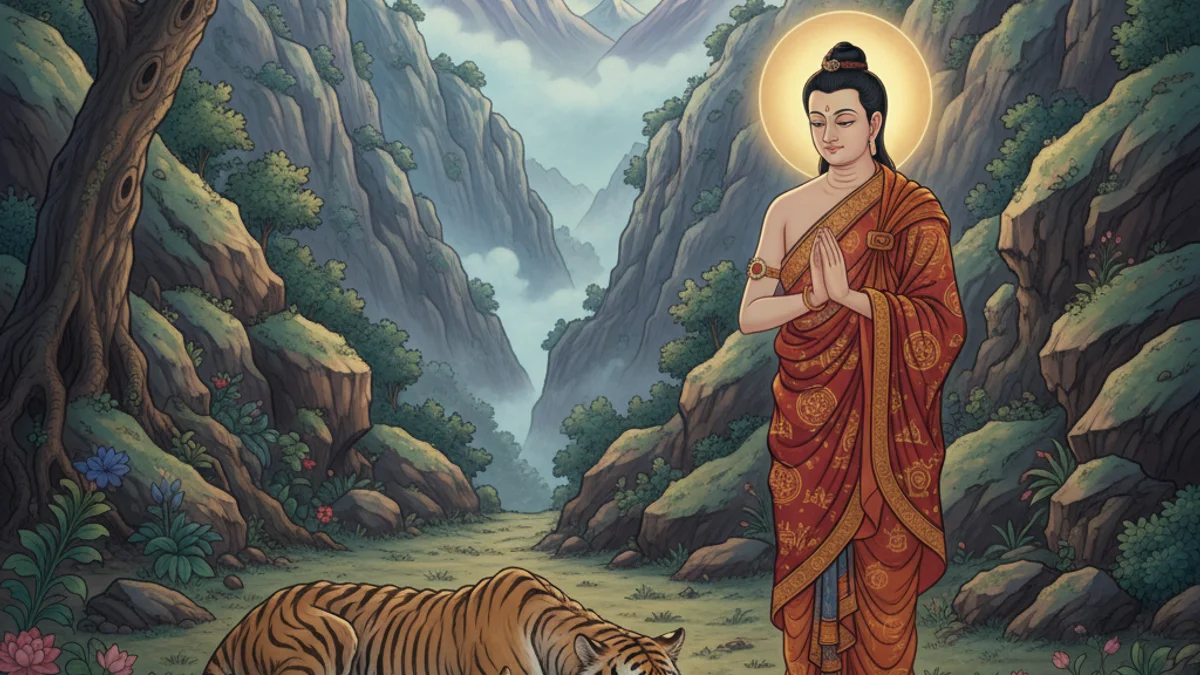
In a kingdom of old, Prince Mahasattva lived with his two brothers. One day, while walking through a deep forest, they came upon a steep cliff overlooking a ravine. At the bottom lay a tigress, so emaciated and weakened by hunger that she could no longer stand. Beside her, her newborn cubs huddled close, unaware that their starving mother was on the verge of devouring them out of sheer desperation. While his brothers hurried away to find food, Mahasattva looked upon the creatures with infinite compassion. He realized that even if they found meat, it might be too late. Understanding that his physical body was temporary and could serve a noble purpose, he climbed down the cliff. Finding the tigress too weak even to bite, he cut his own throat with a sharp splinter of wood, allowing the scent of blood to rouse her. The tigress, revived by his sacrifice, ate his body and was able to nurse her cubs, sparing them all from a tragic end. When the brothers returned, they found only bones and realized the prince had achieved the ultimate perfection of giving.
The Moral
True compassion knows no bounds and the highest form of virtue is the selfless sacrifice of one's own well-being for the sake of others.
“This body is transitory and worthless, but it can be used to save the lives of others.”
Fun Fact
This specific Jataka tale is a popular subject in ancient Buddhist art and can be found depicted in the famous 5th-century murals of the Ajanta Caves in India.
Frequently Asked Questions
What is the moral of The Hungry Tigress?
The moral is the practice of 'Dana Paramita,' or the perfection of giving. It teaches that ultimate compassion involves selflessness and the willingness to sacrifice everything for the life of another living being.
Who was the Prince in The Hungry Tigress?
The Prince, Mahasattva, was a previous incarnation of Siddhartha Gautama, who eventually became the Buddha. These stories illustrate the virtues he perfected over many lifetimes.
Why did the Prince sacrifice himself instead of hunting for food?
He realized the tigress was moments away from eating her cubs or dying. He believed his body was transitory and that giving it to save others was the most meaningful use of his existence.
Where did the story of The Hungry Tigress originate?
It is one of the most famous stories from the Jataka Tales, a body of literature native to India concerning the previous births of Gautama Buddha.
What does the tigress represent in this story?
The tigress represents the suffering and desperation found in the cycle of samsara. She also serves as a catalyst for the Prince to demonstrate his supreme compassion and wisdom.
Is there a physical location associated with this story?
In Buddhist tradition, the Namo Buddha Stupa in Nepal is believed to be the site where Prince Mahasattva sacrificed his body to the starving tigress.
Discussion (0)
Share your thoughts on this story
No comments yet. Be the first to share your thoughts!