Story Summary
Discover the legend of King Canute and the Waves. A powerful king proves to his flattering courtiers that even he cannot command the rising tides of the sea.
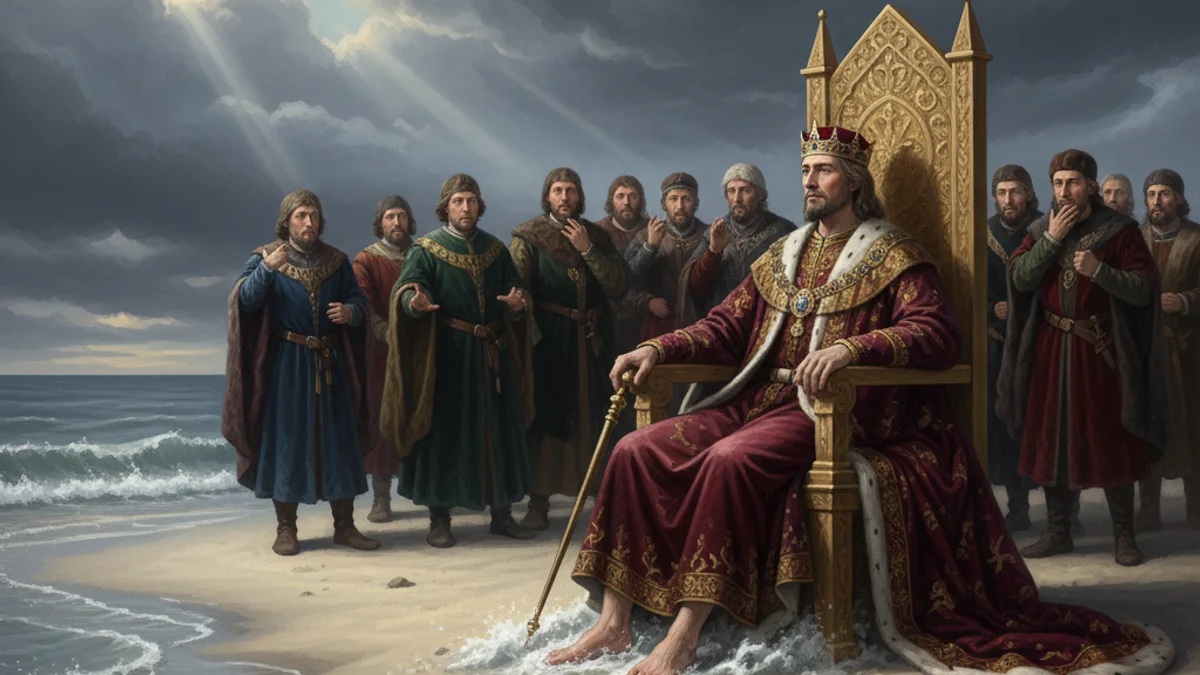
King Canute, the great ruler of England, Denmark, and Norway, was surrounded by fawning courtiers who constantly praised his limitless power. They claimed that even the elements would obey his every command. Tired of their empty flattery, Canute ordered his throne to be carried to the seashore as the tide began to rise. Sitting before the vast ocean, he commanded the water: 'I charge you, do not rise onto my land, nor wet the robes or limbs of your master.' However, the tide continued to advance, soaking the king's feet and legs. Canute turned to his courtiers and declared that the power of kings is nothing compared to the King of Heaven, who alone rules the sea and the earth. From that day on, he never wore his crown again, placing it instead upon a crucifix in the cathedral.
The Moral
True power and authority belong to nature and the divine; even the most powerful human rulers are subject to laws beyond their control.
“Let all the world know that the power of kings is empty and worthless, save for Him by whose will heaven, earth, and sea obey eternal laws.”
Fun Fact
The earliest written account of this story appeared in the 12th century, nearly 100 years after Canute's death, in the writings of Henry of Huntingdon.
Frequently Asked Questions
What is the moral of King Canute and the Waves?
The moral is that earthly power is finite and humble compared to the forces of nature or the divine. Canute used the tide to demonstrate that even a king must submit to a higher power.
Did King Canute really think he could stop the waves?
No, according to the original historical accounts, Canute knew the tide would not stop. He performed the act specifically to prove a point to his sycophantic courtiers who exaggerated his power.
Who was King Canute in real life?
Canute the Great was a real 11th-century monarch who ruled a North Sea Empire consisting of England, Denmark, and Norway. He was one of the most successful and powerful kings in medieval history.
Why is the story of King Canute often misunderstood?
In modern times, 'Canute' is often used to describe someone who arrogantly tries to stop the inevitable. However, the original story portrays him as a wise leader demonstrating his own limitations.
Where did the story of King Canute and the Waves take place?
Tradition suggests the event took place on the shores of England, with locations like Bosham in West Sussex or Southampton often cited as the legendary setting.
What happened to King Canute's crown after the event?
Legend says that after proving his point to the courtiers, Canute hung his crown on a crucifix in Winchester Cathedral and refused to wear it ever again as a sign of humility.