Story Summary
Discover the Jataka tale of The Wounded Swan, where young Prince Siddhartha teaches Devadatta that life belongs to the savior, not the hunter who harms it.
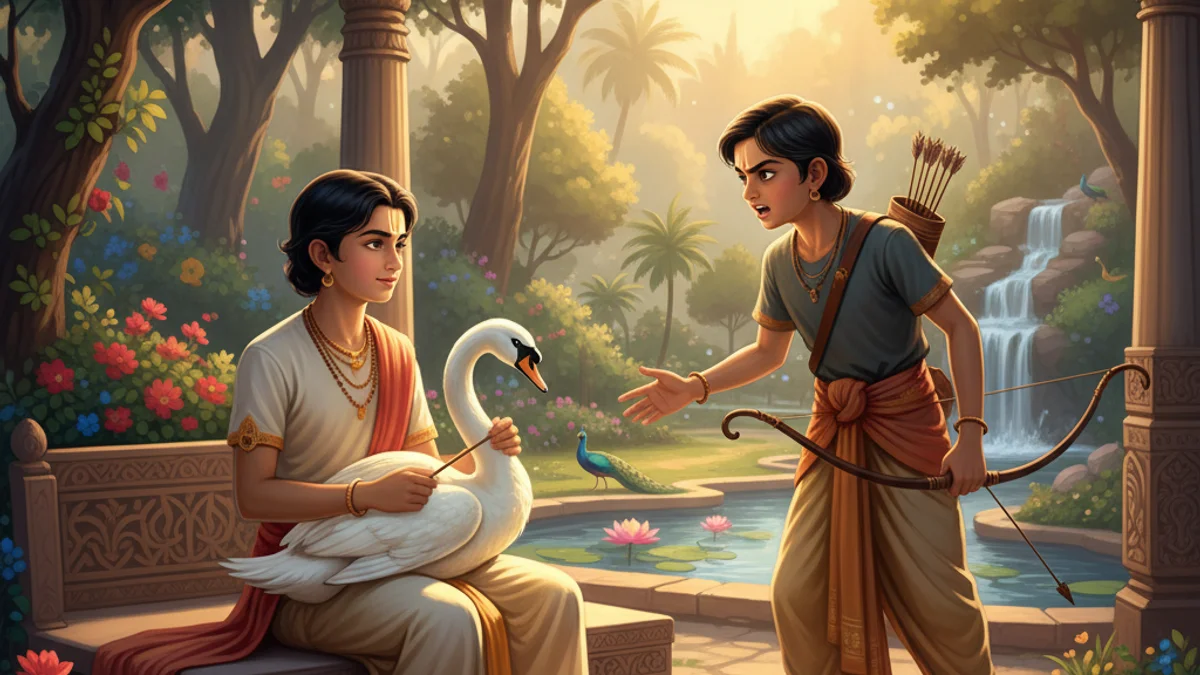
In the palace gardens of Kapilavastu, young Prince Siddhartha was walking when a beautiful white swan fell from the sky, its wing pierced by an arrow. The prince quickly knelt, gently removed the shaft, and used cool water and medicinal herbs to soothe the bird's pain. Moments later, his cousin Devadatta arrived, bow in hand, demanding the swan as his hunting trophy. Siddhartha refused, insisting that the bird was a living being, not a prize. The dispute was brought before the King's court of wise men. Devadatta argued that the bird belonged to him because he was the one who shot it down. Siddhartha countered that a life belongs to the person who saves it, not the one who tries to destroy it. The judges agreed with the prince, ruling that life is the most precious possession of any creature and rightfully belongs to its protector. Siddhartha nursed the swan back to health and eventually released it back into the wild.
The Moral
Life belongs to those who protect and cherish it, rather than those who seek to harm or destroy it.
“Life belongs to the one who preserves it, not the one who seeks to destroy it.”
Fun Fact
This story is often used to illustrate the early rivalry between Siddhartha and Devadatta, who would continue to oppose the Buddha throughout his life.
Frequently Asked Questions
What is the moral of The Wounded Swan?
The moral is that the right to life belongs to the one who saves and protects it. It teaches that compassion is more powerful and righteous than the desire to possess or destroy.
Who shot the swan in the story?
The swan was shot by Devadatta, who was the cousin of Prince Siddhartha. He claimed the bird as his own because he was the one who struck it with his arrow.
Who is Siddhartha in this Jataka tale?
Siddhartha is the young prince who would eventually become Gautama Buddha. The story highlights his innate compassion and wisdom even during his childhood.
How did the King's court decide the fate of the swan?
The court ruled in favor of Siddhartha, stating that a living being belongs to the person who preserves its life rather than the person who tried to take it.
What does the swan symbolize in this story?
The swan symbolizes all sentient life and the vulnerability of living creatures. It serves as a vessel to demonstrate the conflict between ego-driven destruction and selfless compassion.
Why is this story important in Buddhist teachings?
It illustrates the principle of Ahimsa, or non-violence, and Karuna, which is compassion. These are foundational virtues in the path toward enlightenment.
Discussion (0)
Share your thoughts on this story
No comments yet. Be the first to share your thoughts!