Story Summary
Explore the classic Jataka tale of The Monkey Gardeners, where a troop of well-meaning monkeys inadvertently destroys a royal garden through foolish choices.
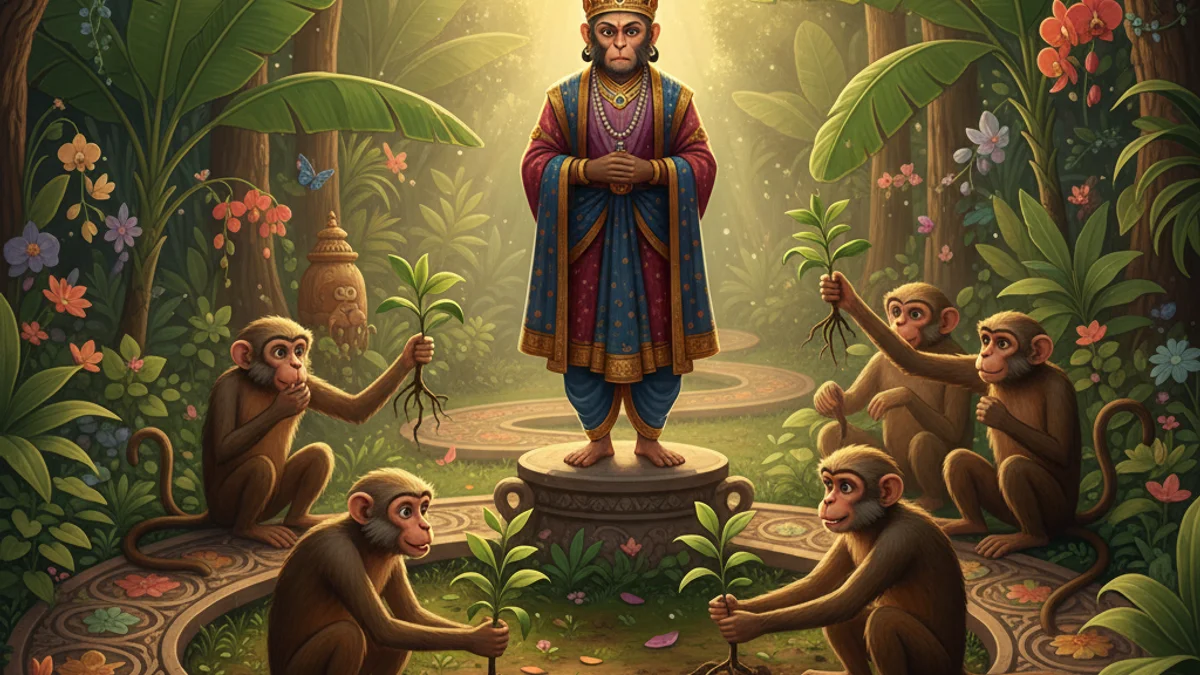
Once, during a grand festival in the city of Varanasi, the King's gardener was eager to join the celebrations. He approached the King of the Monkeys who lived in the royal park and said, 'Friend, will you and your troop water these young saplings while I am away at the festival?' The Monkey King, wanting to be helpful, agreed. However, as the monkeys began their work, the Monkey King had a thought. 'Water is precious,' he told his followers. 'Do not waste it. Pull up each tree to see how deep the roots go. Give plenty of water to those with long roots and only a little to those with short ones.' The obedient monkeys did exactly as they were told, uprooting every delicate sapling in the garden to inspect them. By the time a wise man passed by and saw the destruction, the garden was ruined. He sighed, realizing that while the monkeys meant well, their lack of wisdom had caused a disaster.
The Moral
Good intentions without wisdom can lead to destruction. A foolish friend can cause more harm than a wise enemy.
“A foolish friend who tries to help does more harm than a wise enemy.”
Fun Fact
This story is part of the Pali Canon and has been used for over two millennia to teach children and monks alike about the importance of 'Skillful Means' in Buddhist philosophy.
Frequently Asked Questions
What is the moral of The Monkey Gardeners?
The moral is that good intentions are not enough if they are not guided by wisdom. It teaches us that a fool's help can be more damaging than an enemy's malice.
Why did the monkeys pull up the trees?
The Monkey King instructed them to pull up the trees to check the length of their roots. He believed this would help them determine exactly how much water each tree needed, preventing waste.
What happened to the garden in the end?
The garden was completely ruined. Because the monkeys uprooted the young saplings to inspect them, the delicate plants withered and died under the sun.
Who does the wise man represent in the story?
In many Jataka tales, the wise man represents the Bodhisattva, an enlightened being who observes the world and provides moral clarity on human (and animal) folly.
What is the origin of this story?
This is a Jataka tale, part of a voluminous body of literature native to India concerning the previous births of Gautama Buddha in both human and animal form.
How does the story define 'folly'?
The story defines folly as the act of following instructions or attempting to do good without understanding the basic principles of the task, resulting in unintended consequences.
Discussion (0)
Share your thoughts on this story
No comments yet. Be the first to share your thoughts!