Story Summary
In the classic fable The Lion's Share, a group of animals hunts a stag only for the lion to claim every portion. Learn why power often dictates the prize.
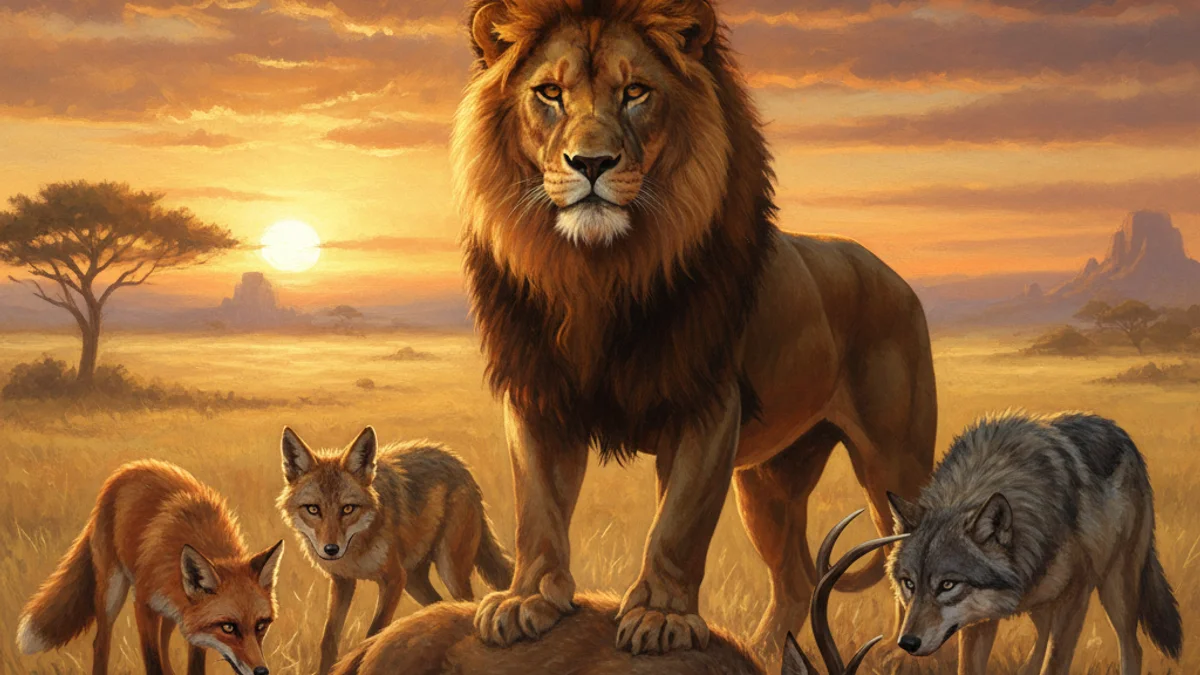
A Lion, a Fox, a Jackal, and a Wolf entered into a partnership and went hunting together. After a long chase, they managed to corner and kill a large stag. The Lion ordered the carcass to be divided into four equal parts. Standing before the prize, he claimed the first portion by right of his title as King of the Forest. He took the second part because of his superior strength and courage. The third portion he claimed for his mate and cubs. Finally, turning a menacing glare toward his companions, he declared that if any of them dared to touch the fourth part, they would have to settle the matter with him. Realizing the danger, the other animals slunk away, leaving the Lion to enjoy the entire kill alone.
The Moral
A partnership with the powerful is never equal. Might often overrides justice when dealing with those who hold all the authority.
“You may take the fourth share if you like, but you will have to reckon with me.”
Fun Fact
The fable's meaning has shifted over time; while the lion originally took 100% of the kill, modern usage of the phrase 'the lion's share' usually implies taking the largest part of a whole.
Frequently Asked Questions
What is the moral of The Lion's Share?
The moral is that an agreement made with a much more powerful party is rarely fair. It warns that 'might makes right' in the eyes of the strong, and the weak often lose their share despite their efforts.
What does the expression 'the lion's share' mean?
In modern English, the phrase refers to the largest portion or the majority of something. Interestingly, in the original Aesop fable, the lion actually took the entire prize, not just the biggest piece.
Who are the main characters in the fable?
The story typically features a Lion as the leader, alongside various forest companions like a Fox, a Jackal, and a Wolf. These animals represent different levels of social or physical status within the hierarchy.
Why did the lion claim all four parts of the stag?
The lion used four different justifications: his royal title, his personal bravery, his family's needs, and finally, a direct threat of violence. This illustrates how a tyrant can always find a reason to justify greed.
How does the fox respond to the lion's actions?
In most versions, the fox and the other animals simply walk away in silence. They recognize that protesting against such a powerful predator would likely result in their own death, choosing survival over fairness.
Is The Lion's Share one of Aesop's Fables?
Yes, it is one of the most famous tales attributed to the ancient Greek storyteller Aesop. It has been translated and adapted for centuries to illustrate the dangers of unequal social and political alliances.