Story Summary
In The Crow and the Pitcher, a thirsty bird uses ingenuity to survive. Discover how persistence and logic overcome physical limitations in this classic fable.
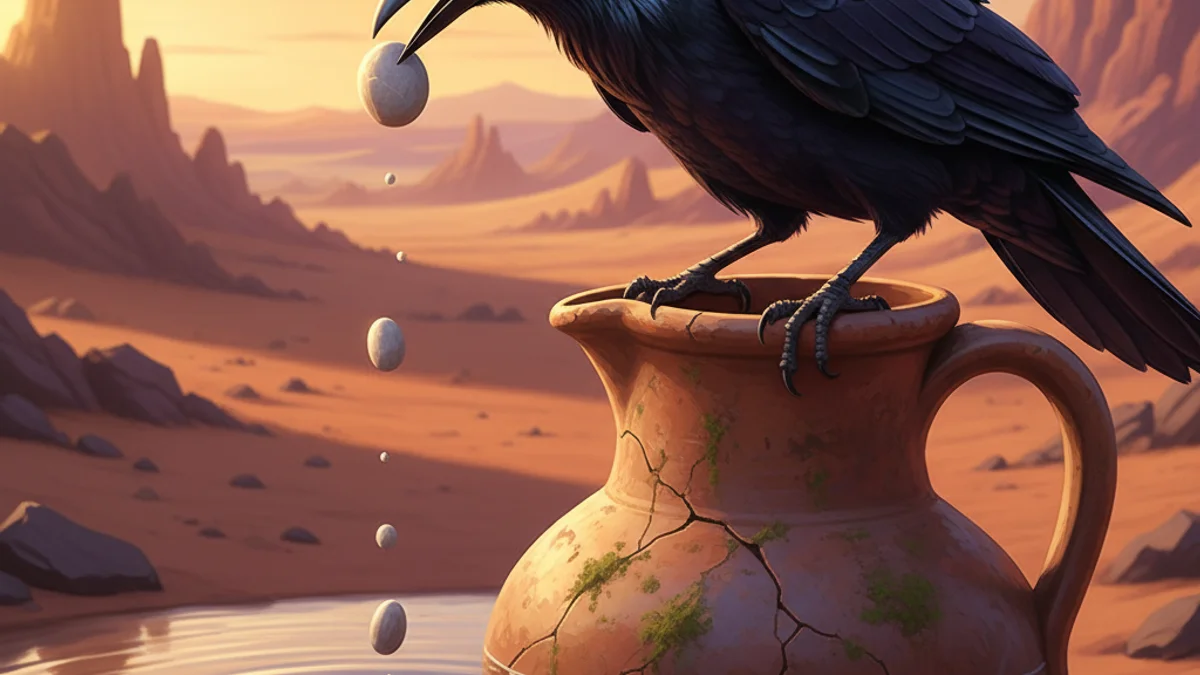
A parched Crow once found a pitcher that had a bit of water at the bottom. However, the pitcher was deep, and no matter how he strained, he could not reach the water with his beak. He tried to tilt the heavy vessel, but it would not budge. Just as he felt despair, he spotted a pile of pebbles nearby. He began dropping the stones into the pitcher one by one. With every pebble, the water rose higher, until at last, it reached the brim, and the clever Crow drank his fill.
The Moral
Necessity is the mother of invention; little by little does the trick.
“Little by little does the trick.”
Fun Fact
Recent scientific experiments have proven that New Caledonian crows actually possess the causal reasoning required to displace water with stones, just like the bird in Aesop's tale.
Frequently Asked Questions
What is the moral of The Crow and the Pitcher?
The primary moral is that 'necessity is the mother of invention.' It teaches that persistence and clever thinking can solve problems that physical strength cannot.
Can real crows actually perform the task in the story?
Yes, scientific studies have shown that corvids, such as crows and ravens, possess the cognitive ability to understand water displacement. They have successfully completed similar tasks in laboratory settings.
Who is the author of The Crow and the Pitcher?
The story is attributed to Aesop, a storyteller believed to have lived in ancient Greece. His fables were originally passed down through oral tradition before being recorded.
What does the pitcher represent in the fable?
The pitcher represents an insurmountable obstacle or a challenge that requires more than just brute force. It symbolizes the limitations of physical reach versus the power of the mind.
Why didn't the crow just knock the pitcher over?
In the story, the pitcher is described as being too heavy or stable for the bird to tip. This constraint forces the crow to find a more creative, intellectual solution to reach the water.
What are the main themes of this Aesop fable?
The main themes include ingenuity, persistence, and problem-solving. It highlights the idea that even small actions, when repeated strategically, can lead to significant success.