
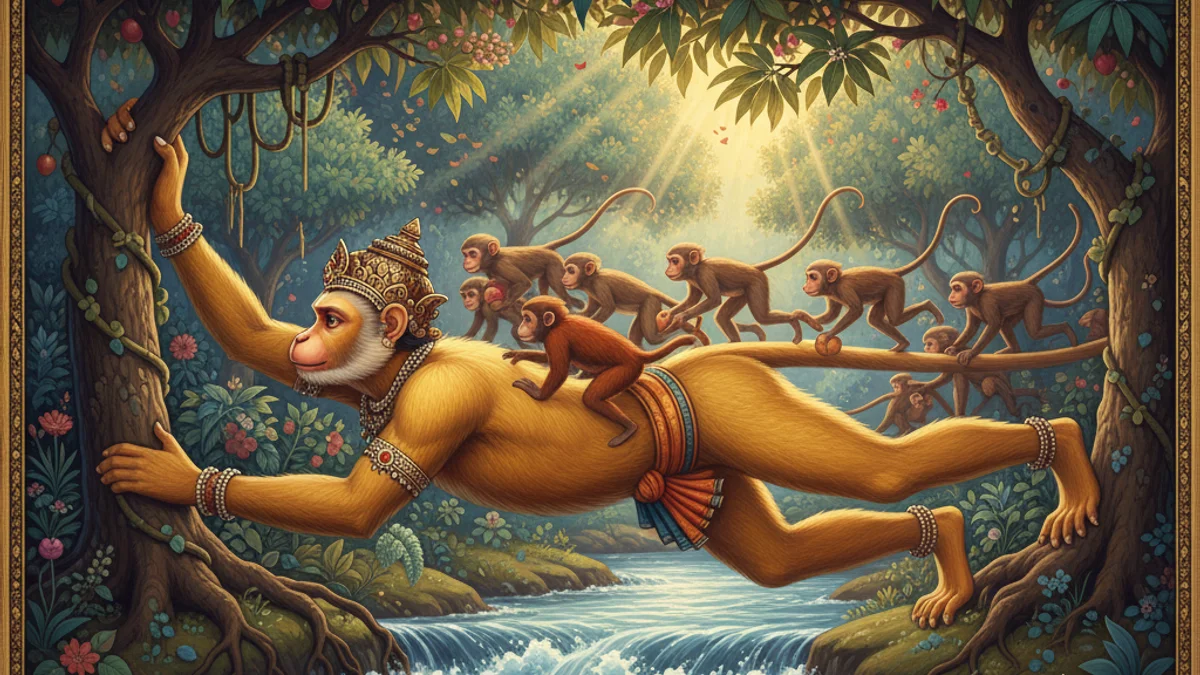
Long ago, the Bodhisattva was born as the King of eighty thousand monkeys. They lived in a magnificent mango tree by the Ganges, bearing fruit of divine sweetness. To protect his tribe from human greed, the Monkey King ordered that no fruit should fall into the river. However, one ripe mango escaped and floated downstream, where it was discovered by the King of Benares. Captivated by the taste, the human King led his army to the tree to claim it, ordering his archers to kill the monkeys. Seeing his tribe trapped, the Monkey King leaped across the river and secured a bamboo pole to a tree on the opposite bank. Finding the vine too short to reach back, he stretched his own body to complete the bridge, gripping the branches tightly. He commanded his followers to run across his back to safety. The last monkey, a long-time rival, jumped with such force that he broke the Monkey King's back. Moved by this incredible act of devotion, the human King lowered the injured leader onto a bed of silk. Before he died, the Monkey King taught the monarch that a ruler's glory lies not in power, but in the selfless protection of those he leads.
True leadership is defined by self-sacrifice and the unwavering commitment to the welfare of others.
Questions about this story
What is the moral of The Monkey King's Sacrifice?
The moral is that a true leader values the lives and safety of their followers above their own. It teaches that leadership is a responsibility of service and sacrifice rather than a position of privilege.
Who does the Monkey King represent in Buddhist tradition?
The Monkey King is the Bodhisattva, which refers to the Buddha in one of his many previous incarnations. These stories illustrate the virtues he perfected on his path to enlightenment.
How did the Monkey King save his tribe?
He jumped across a river to tie a vine to a tree, but when the vine was too short, he used his own body to bridge the gap. He allowed eighty thousand monkeys to run across his back to escape the King's archers.
What is the name of this specific Jataka tale?
This story is known as the Mahakapi Jataka. It is one of the most famous accounts of the Buddha's past lives, emphasizing the perfection of character.
Advertisement


Good night.
