
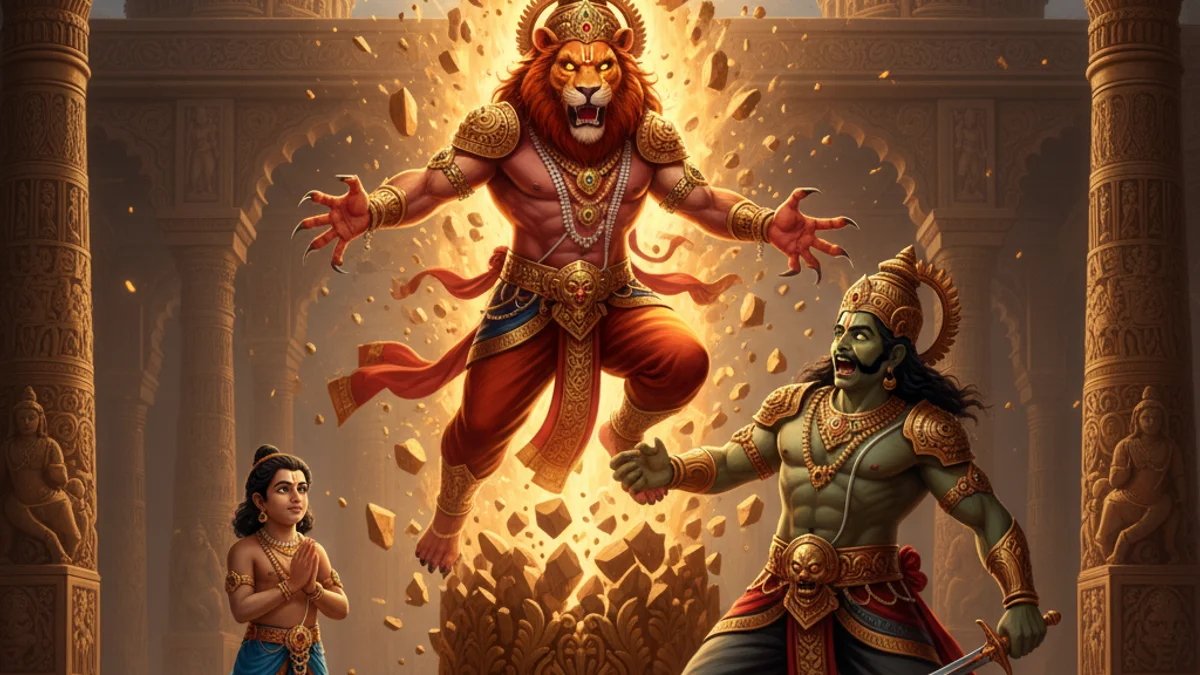
Hiranyakashipu, a powerful demon king, obtained a boon making him nearly immortal. Arrogant in his power, he demanded the world worship him as God. However, his own son, Prahlada, became a devoted follower of Lord Vishnu. Enraged by his son's defiance, the king tried various ways to kill the boy: he was thrown off a cliff, trampled by elephants, and poisoned, yet Prahlada remained unharmed, his mind fixed on Vishnu. Finally, the king's sister, Holika, who was immune to fire, sat with Prahlada in a blazing pyre. By divine grace, Holika was consumed while Prahlada emerged untouched. Reaching his limit, Hiranyakashipu pointed to a stone pillar and mockingly asked if Vishnu was inside it. When Prahlada affirmed God’s omnipresence, the king struck the pillar. From the shattered stone emerged Narasimha—a terrifying half-man, half-lion avatar. Because the king could not be killed by man or beast, indoors or out, at day or night, Narasimha placed him on his lap at the palace threshold during twilight and delivered justice, proving that true faith is invincible.
Unwavering faith in the Divine provides protection against the greatest evils and humbles the most arrogant egos.
Questions about this story
What is the moral of Prahlada's Faith?
The story teaches that sincere devotion and faith are more powerful than any earthly strength. It illustrates that God protects those who surrender to Him completely, regardless of the obstacles they face.
Who was Prahlada's father?
Prahlada's father was Hiranyakashipu, a powerful demon king who hated Lord Vishnu. He sought to replace God and demanded that everyone in his kingdom worship him instead.
How is the festival of Holi related to Prahlada?
Holi commemorates the survival of Prahlada from the fire meant to kill him. The burning of the demoness Holika symbolizes the victory of good over evil and the power of true devotion.
Why did Lord Vishnu take the form of Narasimha?
Narasimha was a half-man, half-lion avatar designed to bypass Hiranyakashipu's special boon. The boon stated he couldn't be killed by a human or animal, making this unique form necessary to defeat him.
Advertisement
Good night.
