
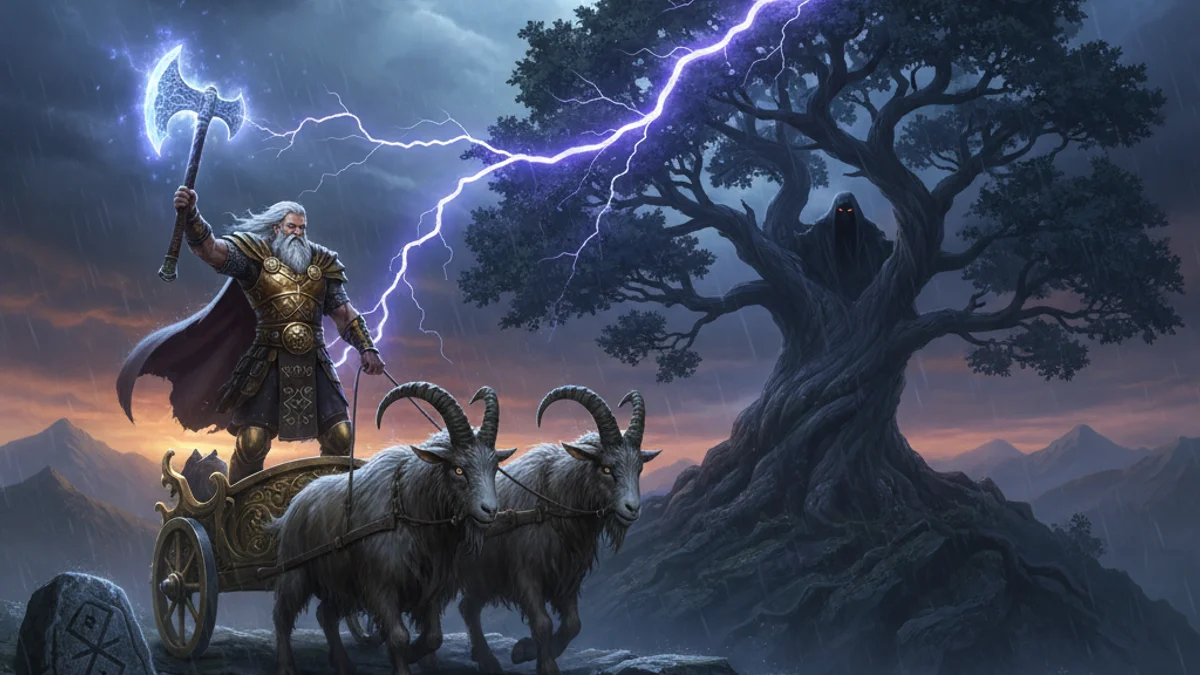
Perkunas, the mighty ruler of the sky, reigned from his mountaintop throne, watching over the world with eyes like flashing flint. Armed with a stone axe that returned to his hand after every strike, he rode across the heavens in a chariot pulled by goats, his wheels rumbling as thunder. His eternal duty was to hunt Velnias, the cunning god of the underworld who sought to steal the sun and bring disorder to the living. Velnias would hide within ancient oaks, beneath heavy stones, or in the hearts of cattle, but Perkunas’s lightning always found him. Each strike was not merely an act of war, but a cleansing of the earth, bringing the rains that nurtured the Lithuanian forests. Through the clash of the storm, Perkunas maintained the cosmic balance, ensuring that light would always prevail over darkness and that the laws of nature remained unbroken.
Justice and cosmic order are inescapable, as the light of truth will eventually find and strike down the shadows of chaos.
Questions about this story
What is the moral of Perkunas the Thunder God?
The moral is that divine justice is inevitable and necessary for the maintenance of world order. It teaches that chaos may hide, but the light of truth and law will eventually find and purge it.
Who is Perkunas in Lithuanian mythology?
Perkunas is the supreme deity of the Baltic pantheon, serving as the god of thunder, lightning, storms, and mountains. He is the enforcer of justice and the protector of the natural world.
Who is the main rival of Perkunas?
His primary antagonist is Velnias, a trickster deity associated with the underworld and chaos. The eternal struggle between the two represents the balance between the sky and the earth, or order and disorder.
What symbols are associated with Perkunas?
He is most commonly associated with the oak tree, the stone axe, the hammer, and the goat-drawn chariot. These symbols represent his strength, his purifying fire, and his role as a celestial laborer.
Advertisement

Good night.
