Story Summary
Experience the Jataka tale of The Banyan Deer, where a golden deer's self-sacrifice moves a king to end all hunting and protect every creature in his realm.
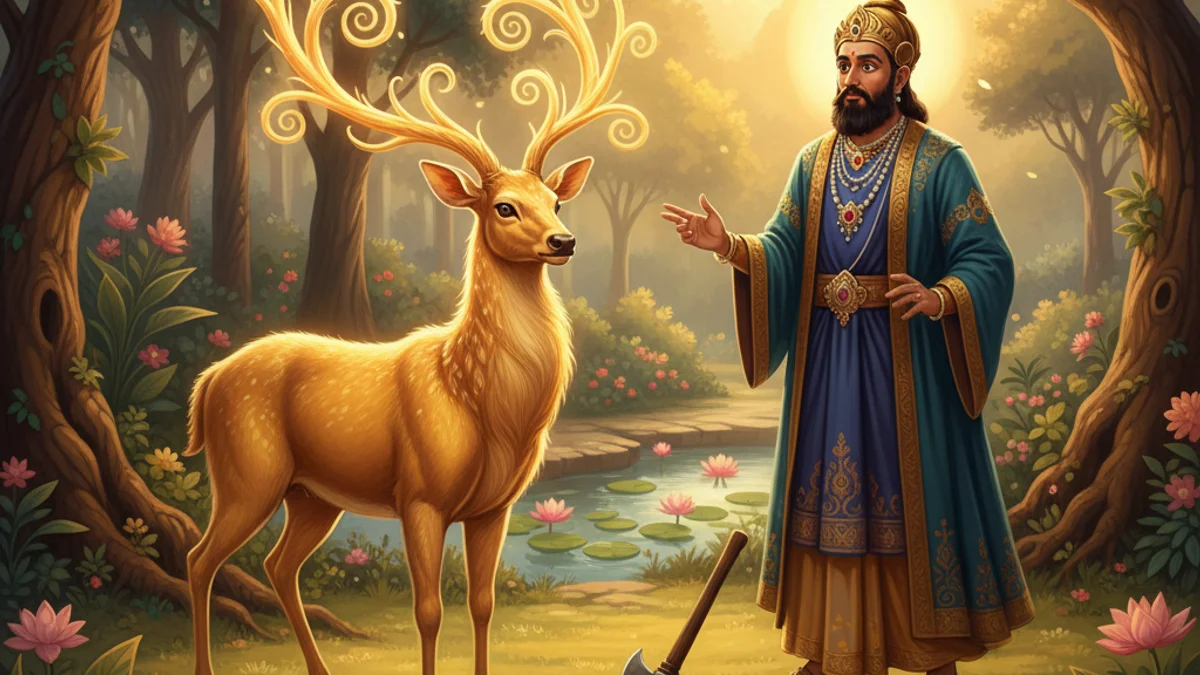
In ancient times, the Bodhisattva was born as a magnificent golden deer known as the Banyan Deer, leader of a great herd. Nearby lived another herd led by a deer named Branch. The King of Benares, a passionate hunter, forced his subjects to drive both herds into his royal park so he could hunt at his leisure. To prevent the terror of the daily hunt, the Banyan Deer and Branch Deer agreed that one deer from their herds would voluntarily go to the chopping block each day by turn. One day, the lot fell to a pregnant doe. She pleaded with Branch to skip her turn until her fawn was born, but he refused. She then turned to the Banyan Deer, who moved by her plight, decided to take her place. When the King saw the golden leader laying his head on the block, he was astonished. 'Great King,' the Banyan Deer said, 'I could not let a mother and her unborn child perish.' Moved to tears by such noble sacrifice, the King granted safety not only to the Banyan Deer and the doe, but to all deer, birds, and fish in his kingdom forever.
The Moral
True leadership and greatness are measured by one's willingness to sacrifice oneself for the sake of others.
“Even among animals, there is one who would give his life for another; how then should a King behave?”
Fun Fact
The Jataka tales, including the story of The Banyan Deer, are among the oldest folk literature in the world, with some versions dating back to the 4th century BCE.
Frequently Asked Questions
What is the moral of The Banyan Deer?
The moral is that true compassion knows no bounds and that a great leader protects the vulnerable even at their own expense. It teaches that one act of self-sacrifice can inspire a transformation of heart in others.
Who does the Banyan Deer represent?
The Banyan Deer represents the Bodhisattva, the Buddha in a previous incarnation, practicing the perfection of compassion and selflessness. These stories are meant to illustrate the long journey toward enlightenment.
Why did the Banyan Deer offer his life for the doe?
He offered his life because the other herd leader, Branch, refused to show mercy to the pregnant doe. The Banyan Deer could not bear the thought of two lives—the mother and her unborn fawn—being taken out of turn.
How did the King of Benares react to the sacrifice?
The King was deeply moved and ashamed of his own cruelty. He realized that even an animal possessed a higher moral character than he did, leading him to grant amnesty to all living beings.
What are Jataka Tales?
Jataka Tales are a voluminous body of literature native to India concerning the previous births of Gautama Buddha in both human and animal form. They are used to teach moral values and Buddhist philosophy.
What happened to the deer herds at the end?
By the end of the story, the King promised that no one in his kingdom would ever harm the deer, birds, or fish again. The Banyan Deer's sacrifice secured peace for all wildlife in the region.
Discussion (0)
Share your thoughts on this story
No comments yet. Be the first to share your thoughts!