Story Summary
Explore the profound tale of Jacob Wrestles the Angel, a night-long spiritual battle that transforms a man into a nation and yields a timeless divine blessing.
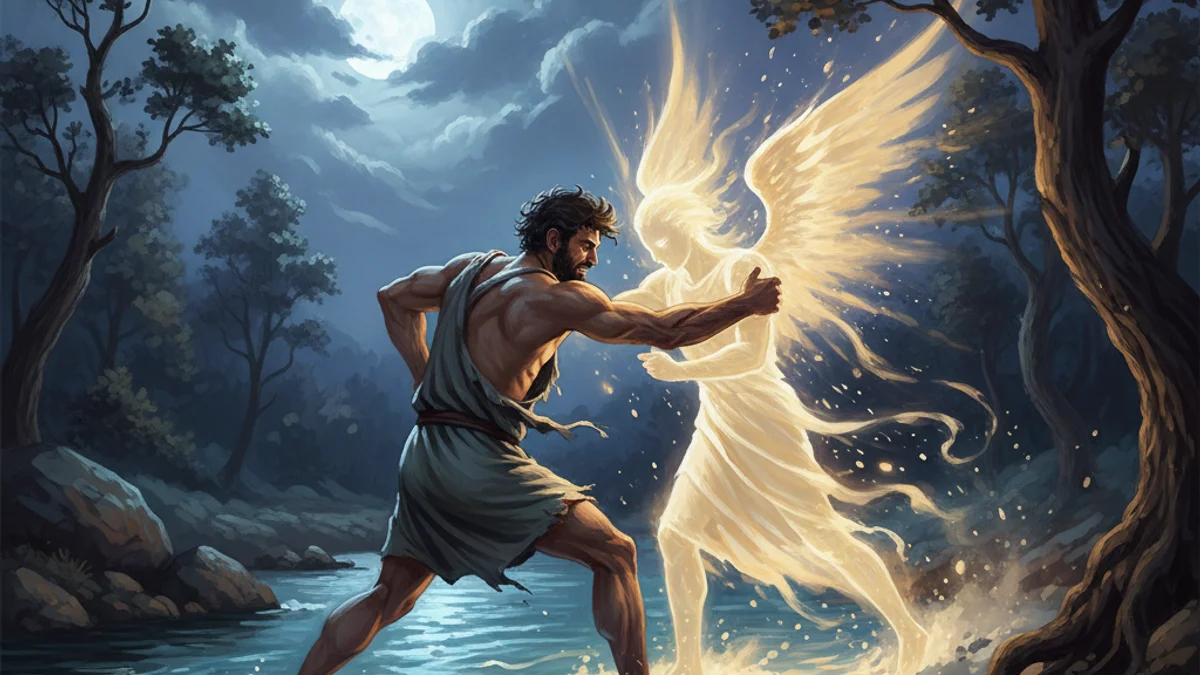
On the eve of a fearful reunion with his estranged brother Esau, Jacob found himself alone on the banks of the Jabbok river. Having sent his family and possessions ahead, a mysterious figure suddenly appeared and grappled with him. They wrestled through the darkness of the night, neither gaining the upper hand. As dawn began to break, the stranger touched the socket of Jacob's hip, wrenching it out of place. Despite the searing pain, Jacob refused to let go, declaring, 'I will not let you go unless you bless me.' The being asked his name, then declared: 'Your name shall no longer be Jacob, but Israel, for you have striven with God and with humans, and have prevailed.' Jacob emerged from the struggle limping but transformed, carrying a new identity and the divine blessing he sought.
The Moral
True spiritual growth often comes through struggle and the courage to face our inner and outer demons.
“I will not let you go unless you bless me.”
Fun Fact
Due to this story, Jewish dietary laws (Kashrut) forbid the consumption of the sciatic nerve, the 'gid hanasheh,' in memory of Jacob's injured hip.
Frequently Asked Questions
What is the moral of Jacob Wrestles the Angel?
The story teaches that spiritual maturity and blessings are often the result of persistence through hardship and the willingness to confront one's past and fears.
Who was the 'man' Jacob wrestled with?
While often called an angel, interpretations vary; some see him as a divine messenger, a manifestation of God, or even a personification of Jacob's own internal struggle.
What does the name 'Israel' mean?
The name Israel is traditionally interpreted as 'He who struggles with God' or 'God strives,' marking Jacob's transition from a deceiver to a spiritual leader.
Why did the angel touch Jacob's hip?
The injury served as a permanent physical reminder of the encounter, ensuring Jacob remained humble and remembered that his victory came through divine interaction.
Why did Jacob refuse to let go of the stranger?
Jacob recognized the supernatural nature of his opponent and realized that this struggle was a pivotal moment to seek redemption and a blessing for his future.
What is the significance of the setting at the Jabbok river?
The river represents a threshold or crossing point, symbolizing Jacob’s transition from his old life of trickery to a new life of responsibility and faith.
Discussion (0)
Share your thoughts on this story
No comments yet. Be the first to share your thoughts!