Story Summary
Explore the legendary encounter in Diogenes and Alexander, where a king's vast power meets a philosopher's simple truth. A classic tale of wealth versus wisdom.
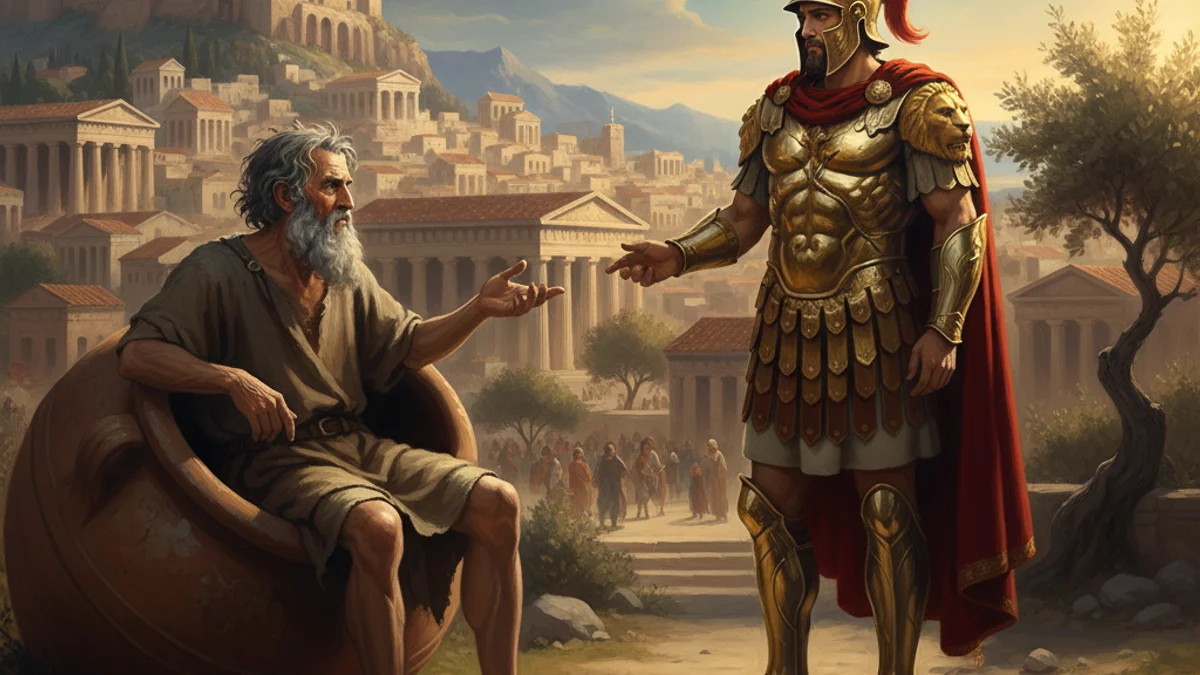
In the city of Corinth, the philosopher Diogenes lived a life of extreme simplicity, making his home inside a large ceramic storage jar. When Alexander the Great, the most powerful conqueror of the age, arrived in the city, he was eager to meet the famous eccentric. Accompanied by his retinue of soldiers and courtiers, Alexander found the philosopher lying in the sun. The king stood over him and asked, 'Diogenes, I have heard much of your wisdom. Is there any favor I can grant you? Ask for anything you desire.' Diogenes, squinting up at the king through the bright light, replied calmly, 'Yes. Stand a little less between me and the sun.' The courtiers were outraged by such insolence toward a king, but Alexander was struck by the philosopher's utter lack of greed or fear. As they walked away, Alexander silenced his followers, saying, 'If I were not Alexander, I would wish to be Diogenes.'
The Moral
True power and freedom come from wanting nothing, as even the world's greatest conqueror cannot provide what nature gives freely.
“Stand a little less between me and the sun.”
Fun Fact
The term 'Cynic' comes from the Greek word 'kynikos,' meaning 'dog-like,' a nickname given to Diogenes because he lived simply and ignored social etiquette like a stray dog.
Frequently Asked Questions
What is the moral of Diogenes and Alexander?
The moral is that true contentment is found in self-sufficiency. It illustrates that material wealth and political power are insignificant compared to the freedom of having no worldly desires.
Where did the meeting between Diogenes and Alexander take place?
The encounter historically took place in Corinth, Greece, during the Craneion, a gymnasium and cypress grove where Diogenes often stayed.
Why did Diogenes live in a tub?
As a Cynic philosopher, Diogenes believed in living 'according to nature.' He rejected social conventions and material possessions, choosing to live in a large ceramic storage jar, or pithos, to demonstrate his independence.
Did the encounter between Diogenes and Alexander actually happen?
While the story is well-documented by ancient biographers like Plutarch and Diogenes Laertius, historians debate if the exact dialogue is verbatim or a legendary illustration of their opposing characters.
What did Alexander mean by his final comment?
When Alexander said he would want to be Diogenes, he was acknowledging that while he sought to master the entire world, Diogenes had already mastered himself, achieving a level of peace Alexander could never have.
What philosophy did Diogenes follow?
Diogenes was a primary figure of Cynicism. This philosophy emphasized living a life of virtue in agreement with nature, marked by the rejection of conventional desires for wealth, power, and fame.