Story Summary
Discover The Master and the Apprentice, a Georgian folk tale where a clever youth uses shapeshifting magic to outwit his wicked sorcerer teacher for freedom.
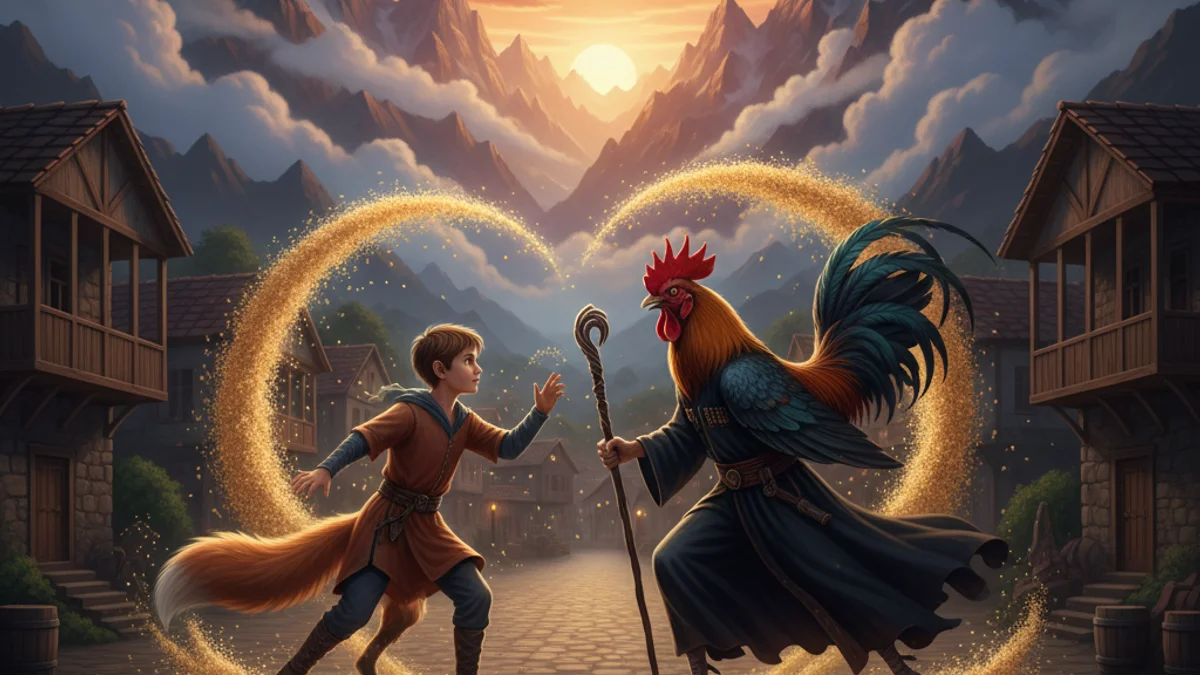
A poor man, desperate for his son's future, apprenticed the boy to a renowned but wicked master craftsman who was secretly a powerful sorcerer. The contract stated that after three years, the father could take the boy back only if he could recognize him. During his stay, the boy secretly learned all his master's dark arts. When the three years passed, the master transformed all his apprentices into identical pigeons, but the boy had previously signaled his father to pick the one with a specific feather ruffled. Having failed to trick the father, the master was enraged. A magical pursuit began: the boy transformed into a horse to flee, and the master became a rider; the boy became a fish, and the master a net. Finally, in a bustling marketplace, the boy turned into a grain of millet. The master turned into a rooster to eat the grain, but the boy instantly transformed into a fox, snapping the rooster's neck. Having surpassed his teacher in both skill and wit, the apprentice returned home a free man.
The Moral
True mastery is not just about learning skills, but having the wisdom and courage to use them for one's own liberation.
“The fox of the forest is always quicker than the rooster of the yard.”
Fun Fact
This tale is a variant of the 'Transformation Chase' motif, which appears in the legends of Taliesin in Welsh mythology and even in the 1001 Nights.
Frequently Asked Questions
What is the moral of The Master and the Apprentice?
The story teaches that intelligence, when paired with the skills of one's oppressor, can be used to achieve freedom. It emphasizes that a student's ultimate success is outgrowing and surpassing a restrictive teacher.
What is the origin of this story?
This is a traditional Georgian folk tale from the Caucasus region. It belongs to a global family of 'Magician and his Pupil' stories found in many Indo-European cultures.
What forms do the characters take during the duel?
The characters transform into various animals and objects including pigeons, horses, fish, nets, millet, a rooster, and finally a fox. Each form is chosen to either escape or capture the other.
How did the father recognize his son among the pigeons?
The boy anticipated the master's trickery and told his father beforehand to look for a specific physical sign, such as a ruffled feather or a specific movement, to identify him.
Is the Master a villain in Georgian folklore?
Yes, in this context, the Master represents a powerful, gatekeeping figure who uses his knowledge for control rather than mentorship, making him the antagonist.
How does the story reflect Georgian culture?
It reflects the value placed on wit and 'kherkhi' (cunning), a trait highly admired in Georgian folklore as a means for the underdog to defeat a more powerful foe.