Story Summary
Discover the Taoist wisdom of The Frog in the Well. A humble tale about a small frog, a sea turtle, and the importance of expanding one's limited perspective.
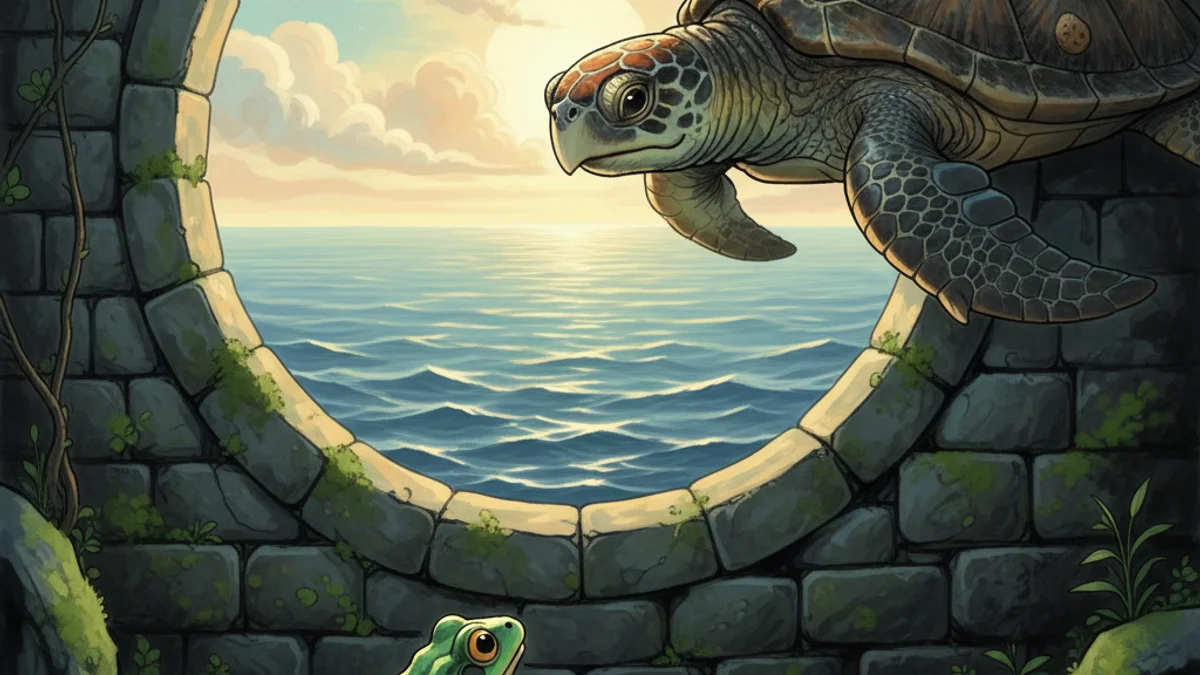
A frog lived happily in a shallow, crumbling well. He boasted to a passing sea turtle, "Look how wonderful my life is! I have the water to swim in and the mud to sleep in. I am the master of this domain. Why don't you come inside and see?" The turtle tried to step into the well, but his left foot got stuck before his right could move. Stepping back, he looked at the frog and said, "Have you ever seen the East Sea? It is more than a thousand miles wide and deeper than a thousand fathoms. Floods do not increase its volume, and droughts do not make it shrink. That is the true happiness of living in the great sea." Upon hearing this, the frog fell into a silent daze, his small world suddenly feeling very tiny indeed.
The Moral
True wisdom begins with realizing how little we know. We should never assume our limited perspective represents the entire truth of the world.
“To a frog in a well, the sky is only as big as the mouth of the well.”
Fun Fact
This story originates from the 'Zhuangzi', one of the two foundational texts of Taoism, dating back to approximately the 4th century BCE.
Frequently Asked Questions
What is the moral of The Frog in the Well?
It warns against arrogance and narrow-mindedness. It teaches that our personal experiences are only a tiny fraction of the vast reality that exists beyond our view.
Who wrote the original story of The Frog in the Well?
The story is a classic parable from the 'Zhuangzi', a fundamental text of Taoism written by the philosopher Zhuang Zhou. It uses humor to illustrate deep philosophical concepts.
What does the 'well' symbolize in the story?
The well represents a person's limited environment, ego, or narrow mindset. It symbolizes the comfort of the familiar that prevents someone from seeking a broader truth.
How does the frog react to the sea turtle's description?
The frog is left speechless and bewildered, experiencing a sudden realization of his own insignificance. His sense of superiority vanishes when confronted with the reality of the vast ocean.
Why is this story important in Taoism?
It illustrates the concept of limited perspective, encouraging practitioners to remain humble and open-minded. It emphasizes that the Tao is infinite and cannot be fully grasped by a single viewpoint.
Is there a common idiom related to this story?
Yes, the Chinese idiom 'Jing Di Zhi Wa' refers to someone with a narrow vision or limited experience who mistakenly thinks they are very knowledgeable.