Story Summary
Discover the Zen koan Nansen Kills the Cat, where Master Nansen challenges his monks to transcend attachment through a shocking act and a pair of sandals.
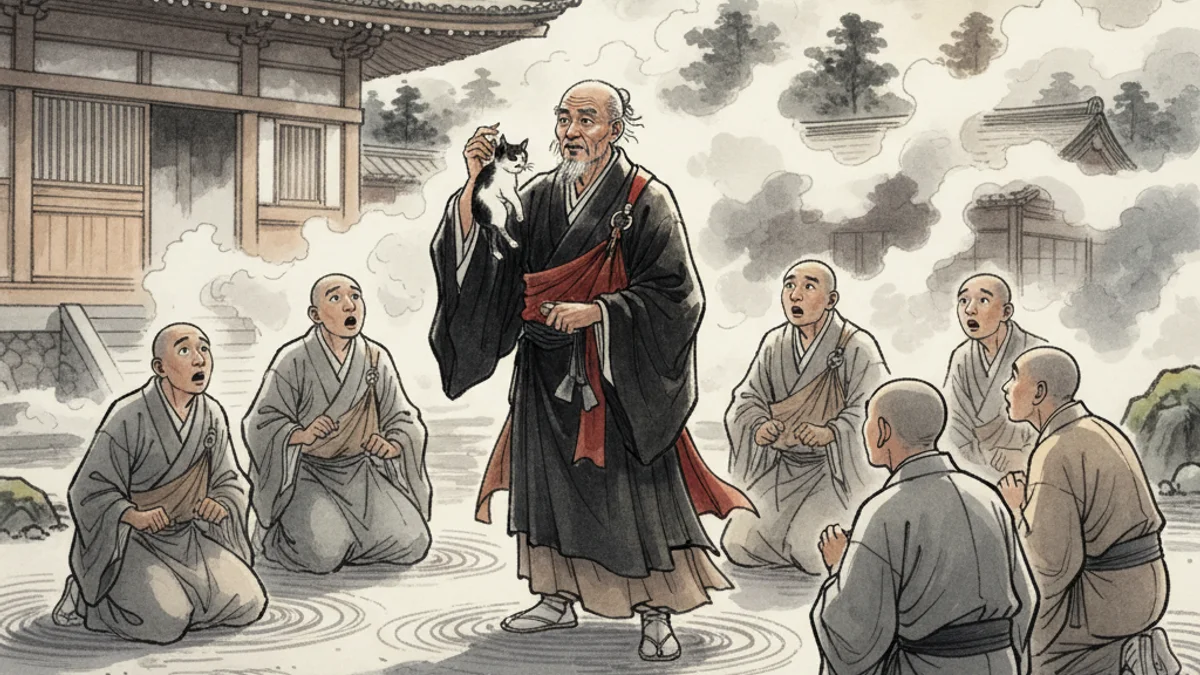
One day, the monks of the eastern and western halls at Master Nansen's monastery were arguing over a cat. Seeing the dispute, Nansen held the cat up and shouted to the assembly, 'If any of you can say a word of Zen, I will spare this cat. If you cannot, I will cut it in two.' The monks remained silent, unable to offer a word of insight. Nansen then proceeded to kill the cat. Later that evening, Nansen's senior disciple Joshu returned. Nansen recounted the day's events to him. Joshu immediately took off his straw sandals, placed them on his head, and walked out of the room without a word. Nansen sighed and said, 'If you had been there, you would have saved the cat.'
The Moral
Attachment to logic and dualistic arguments prevents true understanding; direct, spontaneous action transcends the trap of intellectual debate.
“If you had been there, you would have saved the cat.”
Fun Fact
This koan is one of the most controversial in Zen history because it depicts a master breaking the first precept against killing to teach a lesson.
Frequently Asked Questions
What is the moral of Nansen Kills the Cat?
The moral highlights the danger of dualistic thinking and intellectual attachment. It suggests that when we are caught in 'right versus wrong,' we lose sight of reality and life itself.
Why did Joshu put his sandals on his head?
Joshu's action was a non-dualistic response that showed the absurdity of the monks' argument. By putting shoes where the head belongs, he demonstrated that the world was already upside down due to their petty disputes.
Did Master Nansen really kill the cat?
In the context of the koan, the act is presented as literal to provide a 'great shock' to the student's system. It serves as a radical teaching tool to break through the monks' intellectual stagnation.
What does the cat represent in this Zen story?
The cat represents the object of attachment and the source of conflict. It symbolizes how humans often fight over external things while ignoring the internal state of their own minds.
What is meant by 'a word of Zen'?
A 'word of Zen' is a direct expression of one's Buddha-nature that is not filtered through logic or ego. Nansen was looking for a spontaneous demonstration of wisdom rather than a philosophical explanation.
How does this story relate to The Gateless Gate?
This story is Case 14 in the 'Mumonkan' or 'The Gateless Gate,' a famous collection of 48 Zen koans used by students to attain enlightenment.