Story Summary
In The Hall of Two Truths, the deceased face the ultimate judgment. Discover the ancient Egyptian myth where a heart is weighed against the feather of truth.
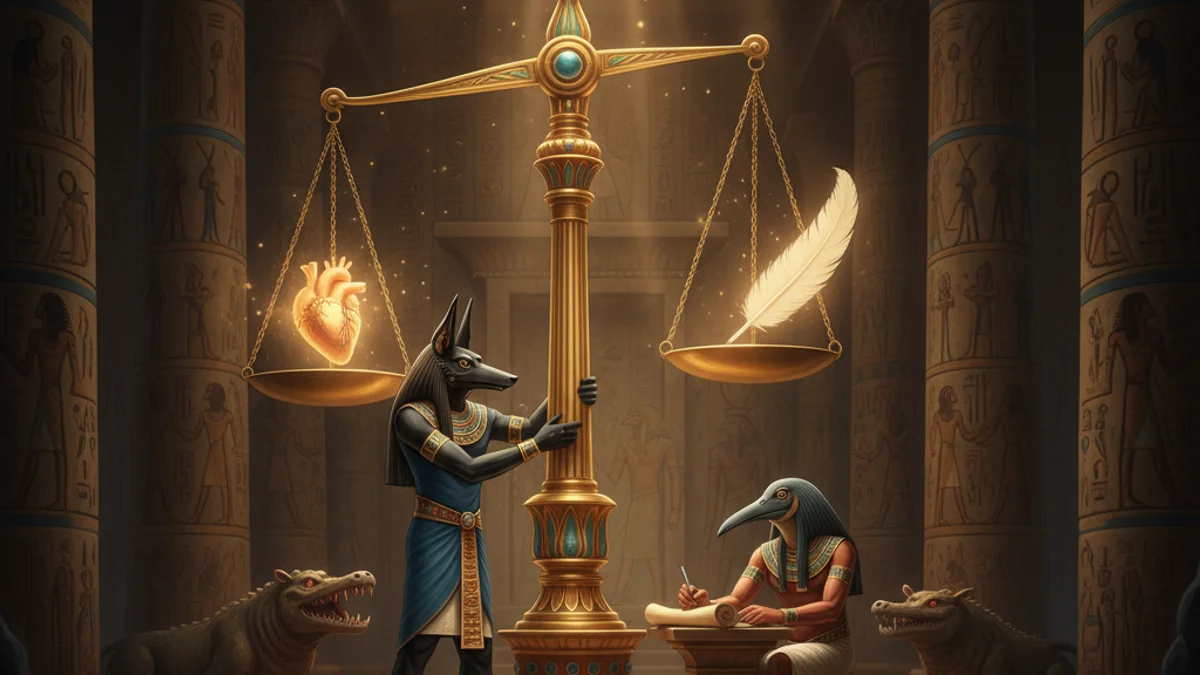
Upon passing from the world of the living, the soul of the deceased journeyed through the perilous Duat to reach the Hall of Two Truths. Here, under the watchful eyes of Osiris, the Lord of the Underworld, the final judgment commenced. Anubis, the jackal-headed god of mummification, led the soul to the great golden scales of justice. On one side lay the traveler’s heart, believed to be the vessel of their earthly deeds. On the other sat the white feather of Ma’at, representing truth, cosmic balance, and divine order. The deceased then recited the 'Negative Confession' before forty-two divine judges, swearing they had committed no crimes against gods or men. If the heart was lighter than or equal to the feather, Thoth, the scribe of the gods, recorded the soul as 'true of voice,' allowing them to enter the eternal paradise of the Field of Reeds. However, if the heart was heavy with sin, the terrifying beast Ammit—part lion, hippo, and crocodile—would devour it, ending the soul's existence forever.
The Moral
One's actions in life determine their eternal destiny, emphasizing the importance of integrity, truth, and moral balance.
“If the heart is found lighter than the feather, the soul shall live forever in the fields of reeds.”
Fun Fact
The 'Negative Confession' found in the Book of the Dead influenced many ancient legal and moral codes, emphasizing what one *did not* do rather than what they did.
Frequently Asked Questions
What is the moral of The Hall of Two Truths?
The story teaches that integrity and truth are the most valuable assets a person can possess. It suggests that our earthly actions have eternal consequences and that a balanced life leads to peace.
Who is Ammit in Egyptian mythology?
Ammit, also known as the 'Devourer of the Dead,' is a funerary deity with the head of a crocodile, the torso of a lion, and the hindquarters of a hippopotamus. She waits by the scales to consume the hearts of those found unworthy.
What happens if the heart is heavier than the feather?
If the heart is found to be heavy with sin and outweighs the feather of Ma'at, the soul is judged as impure. Ammit devours the heart, and the individual suffers a 'second death,' ceasing to exist for all eternity.
Who are the 42 judges in the Hall of Two Truths?
The forty-two judges are divine beings who represent different aspects of Egyptian law and morality. The deceased must address each one by name and swear they have not committed a specific sin associated with that judge.
What is the role of Thoth during the judgment?
Thoth is the god of wisdom and writing who acts as the divine scribe during the ceremony. He carefully records the outcome of the weighing of the heart to ensure the judgment is official and just.
What is the Negative Confession?
The Negative Confession, or the Declaration of Innocence, is a list of 42 sins the deceased claims they did not commit. This includes acts like stealing, lying, or causing harm to others, intended to prove their worthiness.