Story Summary
Discover The Parrot's Tale, a Jataka story where a loyal bird refuses to abandon a withered tree, teaching the King of the Gods the true meaning of gratitude.
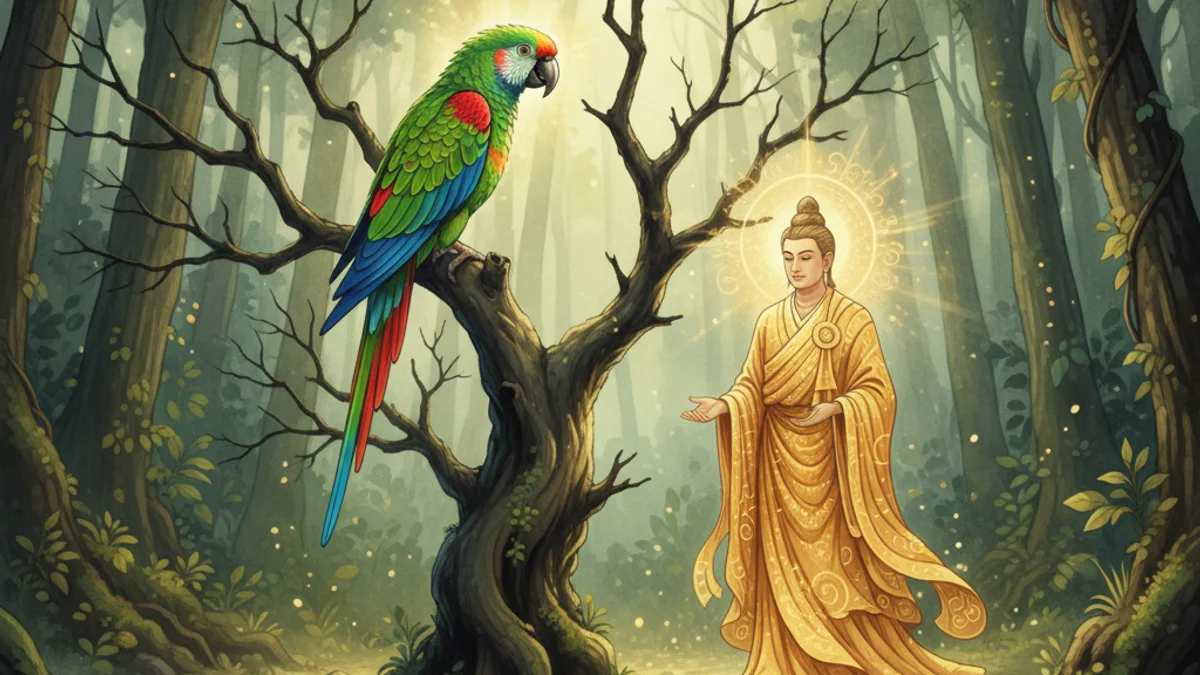
In a lush forest lived a parrot, the Bodhisattva in a past life, who made his home in a magnificent fig tree. For years, the tree provided sweet fruit and cool shade. However, a long drought eventually struck the land. The tree withered, its leaves turned brown, and it ceased to bear fruit. While all the other birds flew away to find greener pastures, the parrot remained. He ate the dry bark and drank what little water he could find, refusing to abandon his old friend. Shakra, the King of the Gods, noticed this and decided to test the bird's devotion. Disguised as a common woodsman, Shakra asked, 'Why do you stay with this dead tree when the forest is full of lush groves?' The parrot replied, 'This tree was my protector and provider for years. It would be ungrateful to leave it simply because it has fallen on hard times.' Deeply moved by this selfless loyalty, Shakra revealed his true form and offered the parrot a boon. The parrot asked only for the tree to be restored to health. Shakra granted the wish, and the fig tree instantly bloomed with vibrant green leaves and succulent fruit, rewarding the parrot's unwavering gratitude.
The Moral
True loyalty and gratitude are shown by standing by friends during their darkest times, not just when they are prosperous.
“A true friend does not abandon their companion when the fruit of life has withered away.”
Fun Fact
Jataka tales are a voluminous body of literature native to India concerning the previous births of Gautama Buddha in both human and animal form.
Frequently Asked Questions
What is the moral of The Parrot's Tale?
The moral is that loyalty and gratitude are the highest virtues. One should never abandon a friend or benefactor just because they can no longer provide benefits or have fallen into hardship.
Who does the parrot represent in the Jataka tales?
The parrot represents the Bodhisattva, who is the Buddha in a previous incarnation. The story highlights his development of the perfection of loyalty and kindness.
Why did the parrot refuse to leave the dying tree?
The parrot felt a deep sense of gratitude because the tree had sheltered and fed him for many years. He believed that leaving just because the tree was barren would be an act of selfishness and ingratitude.
How did Shakra test the parrot's devotion?
Shakra disguised himself as a woodsman and questioned the parrot's logic, pointing out that there were much better trees nearby. He wanted to see if the parrot's loyalty was based on convenience or genuine love.
What reward did the parrot receive for his loyalty?
Instead of asking for something for himself, the parrot asked Shakra to restore the fig tree to life. Shakra granted this, and the tree became lush and fruitful once again.
What is the significance of the fig tree in this story?
The fig tree symbolizes a benefactor or a friend. Its transition from a provider to a withered stump serves as a test of the parrot's character and the depth of his spiritual maturity.