Story Summary
Discover The Merchant and the Five Hundred Robbers, a powerful Jataka tale about how a merchant’s calm wisdom and compassion transformed a band of violent outlaws.
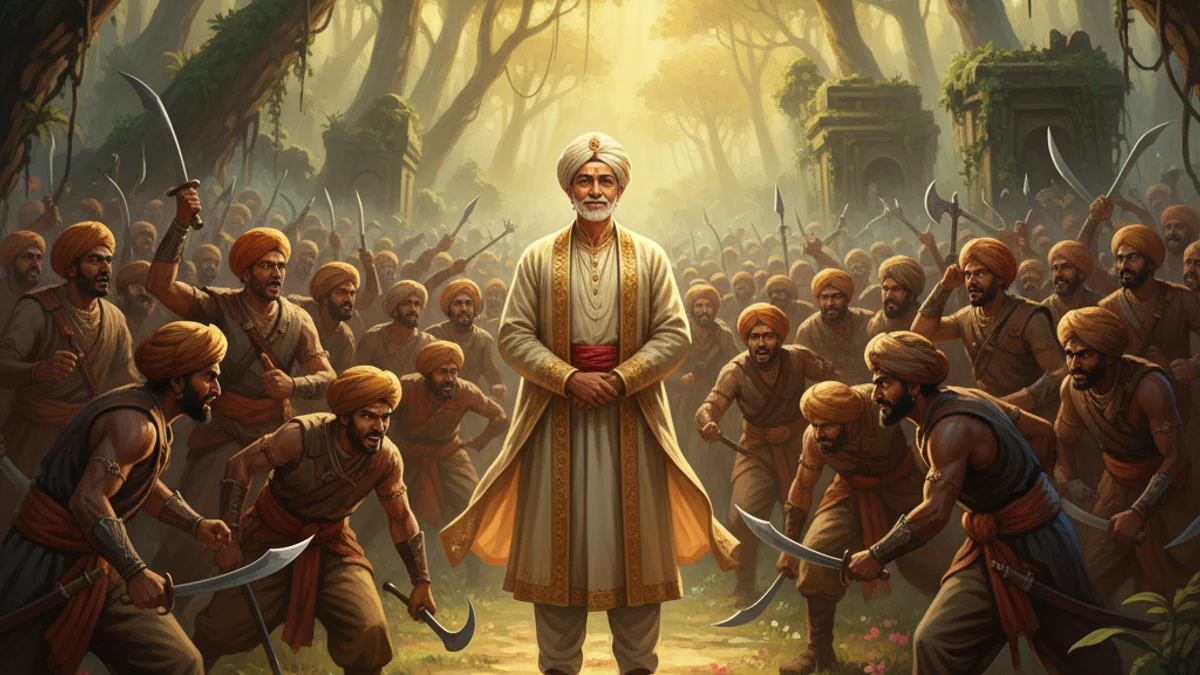
In a time long past, the Bodhisatta was born as a wealthy and wise merchant who traveled across kingdoms with his caravan. One day, while crossing a dense and dangerous forest, his group was suddenly surrounded by five hundred fierce robbers, brandishing swords and spears. While his followers fell to their knees in terror, the merchant remained perfectly calm, his face radiating peace. He greeted the bandits warmly and invited them to share a magnificent feast he had prepared. Stunned by his lack of fear, the robber leader asked, 'Why do you not tremble before us?' The merchant replied that wealth is fleeting and fear is a cage, but a heart full of kindness has nothing to lose. Moved by his profound equanimity and fearlessness, the five hundred robbers realized the emptiness of their violent lives. They threw down their weapons, asked for his forgiveness, and followed the merchant's path of virtue, proving that even the most hardened hearts can be melted by the fire of compassion.
The Moral
True strength lies not in weapons or wealth, but in a calm mind and a compassionate heart that refuses to meet hatred with fear.
“Wealth is fleeting and fear is a cage, but a heart full of kindness has nothing to lose.”
Fun Fact
Jataka tales are one of the oldest collections of literature in the world, with many of the stories appearing in the carvings of ancient Buddhist monuments like the Sanchi Stupa.
Frequently Asked Questions
What is the moral of The Merchant and the Five Hundred Robbers?
The story teaches that non-violence, equanimity, and kindness are more powerful than physical force. It demonstrates that a person who has conquered their own fear can transform the hearts of others.
Who is the merchant in this Jataka tale?
The merchant is the Bodhisatta, the being who would eventually become Gautama Buddha. In this life, he exemplifies the virtues of courage and compassion.
How did the merchant defeat the five hundred robbers?
He did not use weapons; instead, he defeated them with his lack of fear and his overwhelming generosity. By treating them with kindness instead of hostility, he removed their reason to fight.
What happened to the robbers at the end of the story?
Moved by the merchant's wisdom, the robbers renounced their criminal ways. They discarded their weapons and chose to live a life of virtue and peace.
Why is this story important in Buddhist teachings?
It serves as a primary example of 'Metta' (loving-kindness) and 'Upekkha' (equanimity). It shows how spiritual development can protect a person in even the most dangerous situations.
What does the merchant's feast symbolize?
The feast symbolizes the merchant's willingness to give and his lack of attachment to material goods. It acts as a catalyst for the robbers' internal transformation.
Discussion (0)
Share your thoughts on this story
No comments yet. Be the first to share your thoughts!