Story Summary
Discover the legend of Malakas and Maganda, the first man and woman in Filipino mythology born from a single bamboo stalk. A beautiful creation myth of origin.
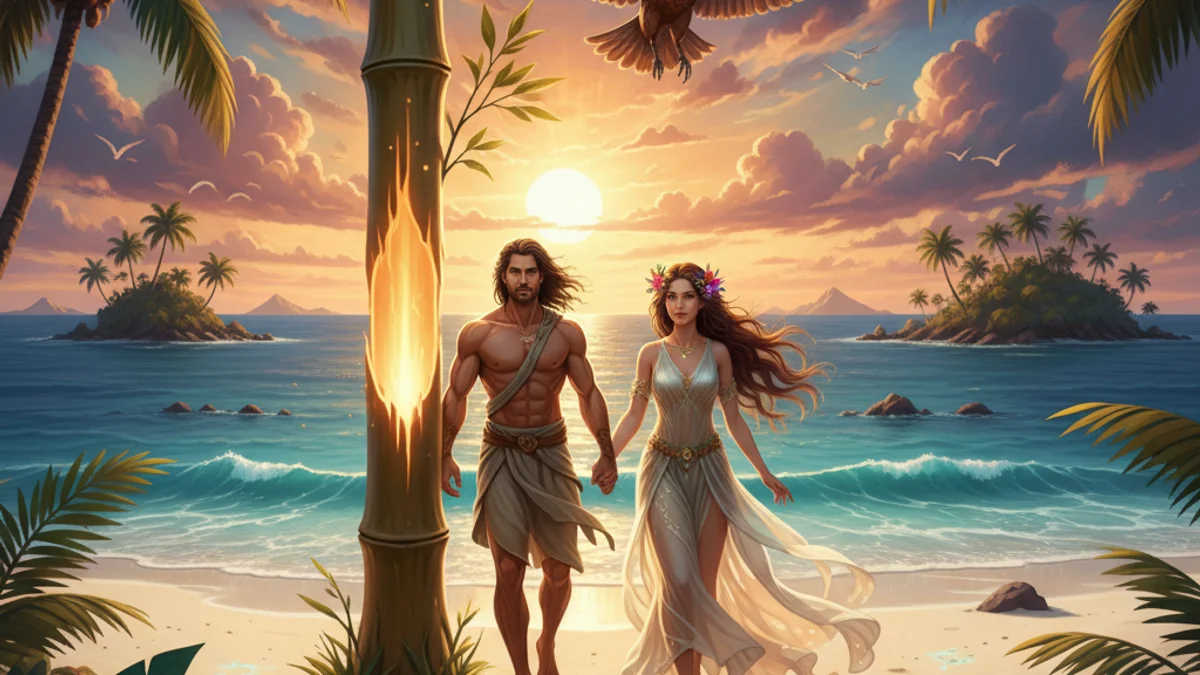
Long ago, when the world was only the sky and the sea, a majestic bird called the Kite flew tirelessly. Seeking a place to rest, the bird stirred the sea into a frenzy, causing it to lash against the sky. To calm the waters, the sky showered the sea with rocks, which became the islands of the Philippines. One day, a large bamboo stalk floated onto the shore and struck the bird’s feet. Annoyed, the bird pecked the bamboo until it split in two. From one half stepped Malakas, the first man, whose name means 'Strong.' From the other half stepped Maganda, the first woman, whose name means 'Beautiful.' They were the first of the human race, born from the same source and destined to populate the islands together as equals.
The Moral
Men and women are born of the same essence and are meant to live in harmony and equality as partners.
“From the same stalk of bamboo, they stepped forth as equals to face the new world.”
Fun Fact
Unlike many Western creation myths where the woman is created after the man, Malakas and Maganda emerge at the same time, reflecting the egalitarian nature of pre-colonial Filipino society.
Frequently Asked Questions
What is the moral of Malakas and Maganda?
The moral is that men and women are created equal, originating from the same source. It emphasizes partnership, mutual respect, and the balance between strength and beauty in the world.
How were Malakas and Maganda born?
According to the myth, they emerged from a single large bamboo stalk that was pecked open by a primordial bird. This signifies their shared origin and deep connection to nature.
What do the names Malakas and Maganda mean?
In the Filipino language (Tagalog), 'Malakas' translates to 'Strong' and 'Maganda' translates to 'Beautiful.' These names represent the primary attributes assigned to the first man and woman.
What role does the bird play in the story?
The bird, often called Manaul, acts as the catalyst for creation. It started the conflict between the sea and sky that formed the islands and eventually cracked the bamboo to release humanity.
Is Malakas and Maganda similar to other creation myths?
Yes, while unique in its bamboo imagery, it shares themes with other 'first couple' myths like Adam and Eve, though it uniquely emphasizes simultaneous creation rather than one being formed from the other.
Why is the bamboo significant in this myth?
The bamboo is a symbol of resilience, flexibility, and utility in Filipino culture. Its role in the myth highlights the sacred relationship between the Filipino people and their natural environment.