Story Summary
Discover the Jataka tale of The Hare's Sacrifice, where a selfless rabbit offers his life to a beggar, leading to his image being immortalized on the moon.
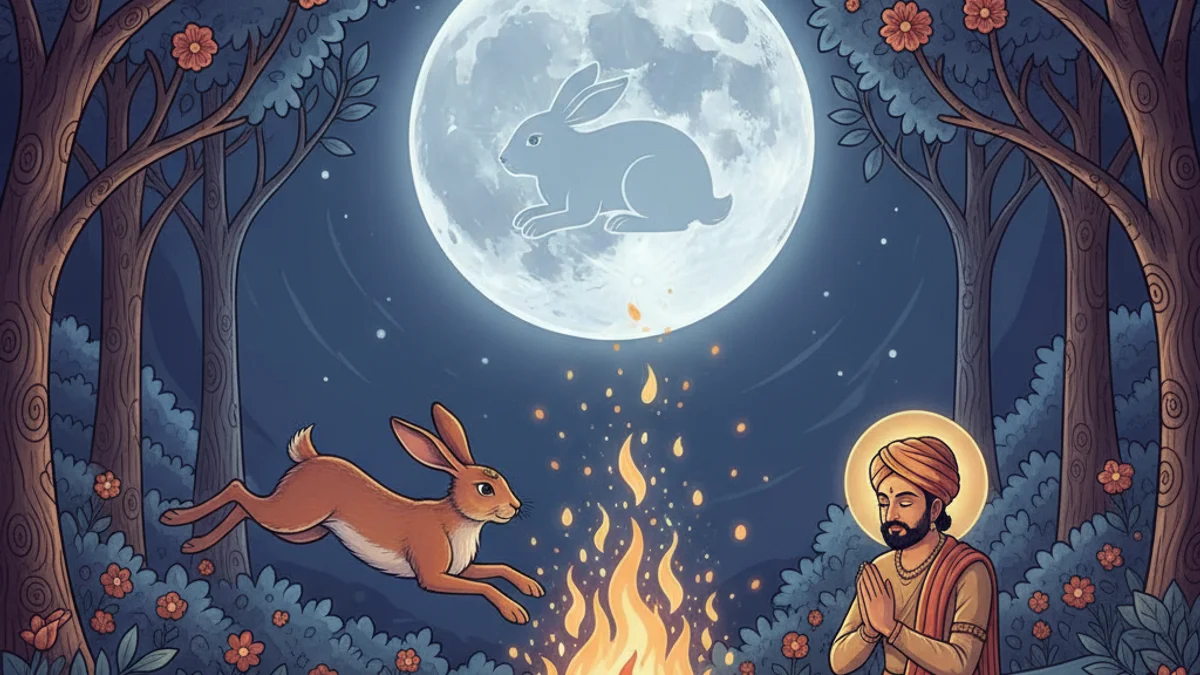
In a lush forest, a wise hare lived alongside an otter, a jackal, and a monkey. One holy day, the four friends resolved to practice charity by offering food to any hungry traveler. The otter gathered fish, the jackal found a lizard and sour milk, and the monkey picked mangoes. However, the hare realized he only had grass to offer, which no human would eat. 'If a beggar comes, I shall offer my own body,' he decided. Sakra, King of the Gods, decided to test their sincerity and descended in the guise of a starving Brahmin. After the others offered their humble food, the Brahmin turned to the hare. The hare told the traveler to prepare a fire. Once the flames grew high, the hare shook his fur to ensure no insects would perish with him and leaped bravely into the blaze. To his amazement, the fire was cool and did not burn him. Sakra revealed his true form and praised the hare's supreme self-sacrifice. To ensure the world never forgot this act of virtue, Sakra drew the image of the hare upon the face of the moon.
The Moral
True generosity is the willingness to sacrifice one's own comfort or life for the sake of others without hesitation.
“He who gives of himself gives the most precious gift of all.”
Fun Fact
This legend is the cultural origin for the 'Moon Rabbit' folklore found across East Asia, including China, Japan, and Korea.
Frequently Asked Questions
What is the moral of The Hare's Sacrifice?
The moral is that true virtue lies in selfless sacrifice and giving of oneself for the welfare of others. It teaches that the intention behind a gift is more important than its material value.
Why is there a rabbit on the moon in Buddhist folklore?
According to the Jataka tale, the god Sakra drew the image of the hare on the moon to honor the hare's willingness to sacrifice his life. This serves as a permanent memorial to his supreme generosity.
Who was the hare in his future life?
In Buddhist tradition, the hare was the Bodhisattva, a previous incarnation of Siddhartha Gautama before he became the Buddha. The story illustrates his perfection of the virtue of generosity.
How did Sakra test the four animals?
Sakra disguised himself as a hungry and exhausted Brahmin beggar. He approached each animal to see if they would fulfill their vow of charity towards a stranger in need.
What did the other animals offer the beggar?
The otter offered seven fish he had found, the jackal offered a lizard and a pot of sour milk, and the monkey offered a bunch of ripe mangoes. Each offered what they had gathered.
Why didn't the fire burn the hare?
The fire was a divine illusion created by Sakra to test the hare's resolve. Because the hare was sincere in his sacrifice, Sakra ensured he remained unharmed by the flames.
Discussion (0)
Share your thoughts on this story
No comments yet. Be the first to share your thoughts!